Snorkeling is a safe, easy, and enjoyable way to explore the world beneath the waves and is open to all ages and skill levels, from children to grandparents. Snorkeling is a great activity for the whole family. Snorkeling is certainly the easiest and least expensive way to enjoy Hawaii's underwater paradise. All you need is a mask, snorkel and fins. Many of Hawaii's top dive sites, particularly the shallow sheltered bays are just as rewarding for snorkelers as they are for divers.
There are many boat operators that offer cruises to popular snorkeling locations on each of the islands and some companies that offer kayaking snorkel trips. If you have never snorkeled before, it is a good idea to seek some instruction before you start and seek some advice on where to go snorkeling for the first time. A great place to begin is in a swimming pool, either at home before coming to Hawaii or at the hotel pool once you arrive. This way you will get used the mask and to breathing through your snorkel in a safe, controlled and confined environment.
Showing posts with label NAUI. Show all posts
Showing posts with label NAUI. Show all posts
Tuesday, August 12, 2008


Hawaiian Dive Sites
Hawaii has year round warm waters and has been a popular scuba dive location for years offering some of the best dive sites in the world. The islands of Hawaii each have their own personalities and characteristics and due to Hawaii's geographical isolation they each offer unique and exciting dive sites, and an abundance of endemic marine life. Select an island for more information on the available dive sites and recommended skill level required to dive at these locations.
Oahu - offers an excellent blend of dive sites that range from offshore lava formations and grottoes to plane and shipwrecks, many with large schools of colorful fish and green sea turtles.
--------------------------------------------------------------------------------
Maui - most of Maui's dive sites are located off the west coast and offers excellent diving for all levels of divers, including Molokini, Black Rock and Five Caves.
--------------------------------------------------------------------------------
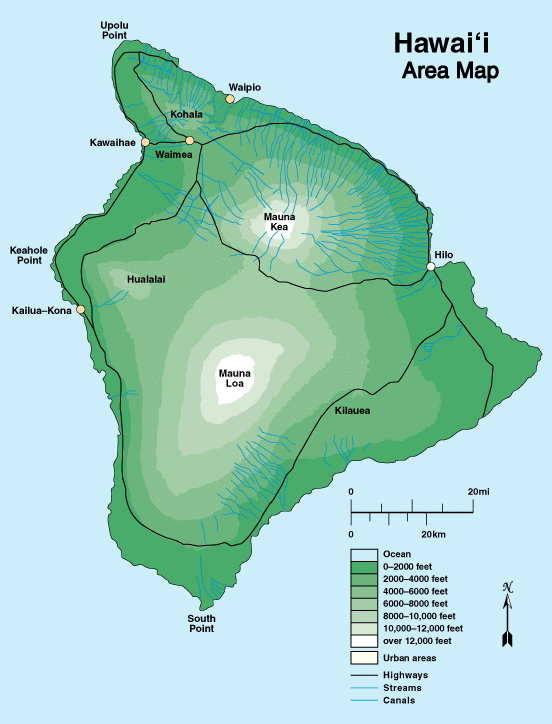
Hawaii - most of the diving on the Big Island is off the leeward coast, with some excellent locations stretched all along the coast. As the coast is sheltered from the trade winds by the large mountains conditions tend to glassy with visibility around 100ft plus.
--------------------------------------------------------------------------------
Kauai - the Garden Island is known for its rugged and pristine diving. During the winter months large swells make the north shore generally inaccessible for diving, but during summer months and on calm days the north shore has some excellent locations.
--------------------------------------------------------------------------------
Ni'ihau - located 17-miles off the southwestern coast of Kauai, is home gigantic sea arches, the endangered monk seal, large pelagic fish and other rare species of fish. Ni'ihau has some amazing dive locations but is generally recommended for intermediate to advanced divers.
--------------------------------------------------------------------------------
Lanai - the dive sites in Lanai are best known for their lava formations which not only house a large variety of marine life but make for some amazing light effects. The lava formations range from archways, ridges, tunnels, pinnacles.
--------------------------------------------------------------------------------
Molokai - Along the entire South side of the island of Molokai lies the longest barrier reef in Hawaii. Seldom visited by divers, this natural sanctuary offers some of the best diving in the islands.
Oahu - offers an excellent blend of dive sites that range from offshore lava formations and grottoes to plane and shipwrecks, many with large schools of colorful fish and green sea turtles.
--------------------------------------------------------------------------------
Maui - most of Maui's dive sites are located off the west coast and offers excellent diving for all levels of divers, including Molokini, Black Rock and Five Caves.
--------------------------------------------------------------------------------
Hawaii - most of the diving on the Big Island is off the leeward coast, with some excellent locations stretched all along the coast. As the coast is sheltered from the trade winds by the large mountains conditions tend to glassy with visibility around 100ft plus.
--------------------------------------------------------------------------------
Kauai - the Garden Island is known for its rugged and pristine diving. During the winter months large swells make the north shore generally inaccessible for diving, but during summer months and on calm days the north shore has some excellent locations.
--------------------------------------------------------------------------------
Ni'ihau - located 17-miles off the southwestern coast of Kauai, is home gigantic sea arches, the endangered monk seal, large pelagic fish and other rare species of fish. Ni'ihau has some amazing dive locations but is generally recommended for intermediate to advanced divers.
--------------------------------------------------------------------------------
Lanai - the dive sites in Lanai are best known for their lava formations which not only house a large variety of marine life but make for some amazing light effects. The lava formations range from archways, ridges, tunnels, pinnacles.
--------------------------------------------------------------------------------
Molokai - Along the entire South side of the island of Molokai lies the longest barrier reef in Hawaii. Seldom visited by divers, this natural sanctuary offers some of the best diving in the islands.
Wednesday, February 6, 2008
Marine Life of Hawai'i
Marine Life of Hawai'i
Glossary of Technical Terms
CALYX (plural, CALICES): depression that houses the polyp
COENOSTEUM: common surface of corallum between calices
COLUMELLA: central structure of the calyx formed by fusion of the septa
CORALLUM (plural, CORALLA): skeleton of entire coral colony
CORALLITE: skeleton produced by an individual polyp
COSTA (plural, COSTAE): extensions of the septa outside the calyx unto the coenosteum
PAPILLAE: rounded nipple-like projections covering the coenosteum; found in Montipora
THECA: wall of corallite
SEPTUM (plural, SEPTA): : skeletal plates that project into the calyx from the theca; may be subdivide into primary, secondary, and tertiary septa
VERRUCAE: small cylindrical projections arising from the corallum that contain calices; found in Pocillopora
Glossary of Technical Terms
CALYX (plural, CALICES): depression that houses the polyp
COENOSTEUM: common surface of corallum between calices
COLUMELLA: central structure of the calyx formed by fusion of the septa
CORALLUM (plural, CORALLA): skeleton of entire coral colony
CORALLITE: skeleton produced by an individual polyp
COSTA (plural, COSTAE): extensions of the septa outside the calyx unto the coenosteum
PAPILLAE: rounded nipple-like projections covering the coenosteum; found in Montipora
THECA: wall of corallite
SEPTUM (plural, SEPTA): : skeletal plates that project into the calyx from the theca; may be subdivide into primary, secondary, and tertiary septa
VERRUCAE: small cylindrical projections arising from the corallum that contain calices; found in Pocillopora
Tuesday, February 5, 2008
Beach at Hanauma Bay
The beach at Hanauma Bay has been a popular gathering spot... (Tom Wharton/The Salt Lake Tribune )«1»HANAUMA BAY, Hawaii - Few people who snorkel ever forget their first experience with a mask and fins in tropical waters.
Mine came in the late 1980s during my first trip to Hawaii. Famed Utah sportscaster Paul James told me about a reserve where fishing was not allowed called Hanauma Bay (ha-NOW-ma) and said it was one of the best things to do near Honolulu.
Another friend who lived there concurred. So, with rented snorkel gear and bags of frozen string beans and peas, we headed to the beautiful half-moon-shaped bay that is a water-covered dormant volcano crater filled with turquoise water, coral reefs and thousands of tropical fish.
It was, indeed, an amazing experience. Colorful fish of all shapes and sizes swarmed us, eating the green beans out of our bathing trunks or hands. I had never seen anything like it.
We also walked to a famous blow hole called the Toilet Bowl and marveled while watching locals swim into a lava tube and then come out the other side, a claustrophobic experience I would never attempt.
What we didn't think about was the fact that many of the things the millions of annual visitors to Hanauma Bay were doing - feeding the fish, stepping on coral and eroding the sides of hills - were damaging this precious site.
Making a return visit last August, we found a far different place. If the parking lot is full, no more cars allowed. Visitors must see a video and hear interpreters talk about how to protect the park. The beach is far less crowded, and trails on each side of the volcano have been closed for safety reasons.
"This has been a major control measure to prevent overcrowding on the beach," explained Alan Hong, Hanauma Bay manager. "When we had over 3 million visitors a year with no restrictions, it caused a lot of environmental impact. We're trying to reduce the impact by reducing the number of people. Those who come are exposed to an orientation program to know what they can do to minimize the impact to our reef. We have reduced the number of visitors to a million a year on the beach."
In fact, the history of the bay's management is replete with management practices that have changed its ecology and encouraged its human use in different ways.
According to the park Web site, www.co.honolulu.hi.us/parks/facility/hanaumabay
, some of the earliest development on the site came in the 1890s, when an old photo shows a building that was probably used by Hawaiian royalty. In 1928, the city and county of Honolulu established Koko Head Regional Park, which included Hanauma Bay, by buying it for $1 from the estate of Bernice Bishop with a deed restricting its use to public parks and rights of way.
A new paved road came in 1931, and the area was protected with barbed wire after Pearl Harbor was bombed. A road to the beach was built in 1950 along with restrooms and showers. An easement for an undersea trans-Pacific telephone cable allowed a 200-foot-wide swath to be cut through the coral reef with tons of rock removed. That actually created more swimming space and created a new biological zone inside the reef for small invertebrates that fish fed upon.
But, by the 1960s, the area was overfished and few fish could be seen. According to the Web site, the Hawaii Division of Fish and Game declared the bay a Marine Life Conservation District, ending the taking of marine life, shells, coral, rocks and sand.
That led to the Hanauma Bay I experienced in the 1980s but also to overcrowding. The nature center was completed in 2002 and the increased management has, according to Hong, reduced visitation.
"There are in the neighborhood of 200 marine animals in the bay, but the fish are what people focus on," said Hong. "You will probably see maybe two different species when you go snorkeling, but the typical snorkeler will remember the most colorful, biggest ones that swam right in front of them."
Despite the restrictions, Hanauma Bay remains one of Honolulu's biggest attractions. If you are staying in Waikiki, you would do well to sign up for one of the commercial bus tours as opposed to driving a car; parking is limited.
Hong said the busiest times of year are when school is out: June, July and August, March and April spring breaks and the Christmas holiday season.
---
* TOM WHARTON can be contacted at wharton@sltrib.com. His phone number is 801-257-8909. Send comments about this story to livingeditor@sltrib.com.
Hanauma Bay basics
* THE BAY is 10 miles east of Waikiki on the Kalaniana'ole Highway.
* NO PETS, alcoholic beverages, fishing, feeding fish or removing or harming marine life are allowed.
* CALL 808-396-4229 for a recorded message with all current fees, times and condition.
* ENTRY FEE is $1 per car and $5 per person 13 years or older.
* VISITORS ARE REQUIRED to watch an educational film before going to the beach.
* LIFEGUARDS are available.
* THERE ARE picnic facilities with tables, a concession stand, restÂrooms, showers, phones, snorkel, mask and fin rental, locker rental and a gift shop.
* THE BEACH is wheelchair accessible via shuttle bus or trolley.
KEYWORDS:
Advance Scuba training, Adventure Sports, Basic Open Water, Digital Underwater Photography, Extreme Scuba and Jason Kilgore, family travel, sharks, discount travel, Enriched Air, Hawaii Scuba Diving, Hawaiian Islands sight seeing, ITAN, Kona, NAUI, NOAA, other specialty certifications, sharks, SSI, TDI/SDI, airlines, family travel, family vacations, Hawaii reef divers, Hawaiian Islands, hotels, Jason Kilgore, Maui, scuba certification, scuba diving, scuba rental gear, Scuba Hawaii, Hawaii Travel, Caribbean Scuba, Scuba Certification, Scuba Jay, Costa Maya Scuba Dive, Gear, Cave Diving, TDI, Water Rescue Diving, Water Rescues, PADI Technical Scuba Diving, Dive Rescue, Scuba Dive Answers, Jason Kilgore and Martial Arts, Jason Kilgore and USANA, Jason Kilgore and Karate, Jason Kilgore and Scuba Diving, Sacramento, auburn, California, Hawaii, Jason Kilgore and Sierra Foothills Karate, Sierra Foothills Karate and Scuba Diving, Jason Kilgore and Scuba Diving, snorkel and fins, vacation, Basic Open Water, Extreme Scuba and Jason Kilgore, Hawaiian Islands, PADI Divemaster SCUBA Certification, Snorkel Bob, Snorkeling/Fin, TDI/SDI, Underwater Instructors, airlines, Divemaster scuba, family vacations, Reef Relief, coral reef, reef fish, maui divers, dive shops, scuba dive shops, cave diving, ice diving, wreck diving, Shark Diving, Shark Exploration, Baja, South America, vacation, Scuba and Jason Kilgore, Naui and Jason Kilgore, How to scuba dive?, skin diving, snorkel, mask, fins, sight seeing, hotels, Jason Kilgore and Hawaiian islands, Kona, Maui, other specialty certifications, Ocean Conservancy, International Coastal Cleanup, Costa Maya Hotel, Mexico Hotels, Mexico Scuba Diving, Diving in South American Scuba, Crabs, Sea Slugs, Marine Animals, Wildlife, Florida, Southern States, Marine Life, Pacific States, Pacific Northwestern States, California, hawaii beaches, hawaiian life style
Mine came in the late 1980s during my first trip to Hawaii. Famed Utah sportscaster Paul James told me about a reserve where fishing was not allowed called Hanauma Bay (ha-NOW-ma) and said it was one of the best things to do near Honolulu.
Another friend who lived there concurred. So, with rented snorkel gear and bags of frozen string beans and peas, we headed to the beautiful half-moon-shaped bay that is a water-covered dormant volcano crater filled with turquoise water, coral reefs and thousands of tropical fish.
It was, indeed, an amazing experience. Colorful fish of all shapes and sizes swarmed us, eating the green beans out of our bathing trunks or hands. I had never seen anything like it.
We also walked to a famous blow hole called the Toilet Bowl and marveled while watching locals swim into a lava tube and then come out the other side, a claustrophobic experience I would never attempt.
What we didn't think about was the fact that many of the things the millions of annual visitors to Hanauma Bay were doing - feeding the fish, stepping on coral and eroding the sides of hills - were damaging this precious site.
Making a return visit last August, we found a far different place. If the parking lot is full, no more cars allowed. Visitors must see a video and hear interpreters talk about how to protect the park. The beach is far less crowded, and trails on each side of the volcano have been closed for safety reasons.
"This has been a major control measure to prevent overcrowding on the beach," explained Alan Hong, Hanauma Bay manager. "When we had over 3 million visitors a year with no restrictions, it caused a lot of environmental impact. We're trying to reduce the impact by reducing the number of people. Those who come are exposed to an orientation program to know what they can do to minimize the impact to our reef. We have reduced the number of visitors to a million a year on the beach."
In fact, the history of the bay's management is replete with management practices that have changed its ecology and encouraged its human use in different ways.
According to the park Web site, www.co.honolulu.hi.us/parks/facility/hanaumabay
, some of the earliest development on the site came in the 1890s, when an old photo shows a building that was probably used by Hawaiian royalty. In 1928, the city and county of Honolulu established Koko Head Regional Park, which included Hanauma Bay, by buying it for $1 from the estate of Bernice Bishop with a deed restricting its use to public parks and rights of way.
A new paved road came in 1931, and the area was protected with barbed wire after Pearl Harbor was bombed. A road to the beach was built in 1950 along with restrooms and showers. An easement for an undersea trans-Pacific telephone cable allowed a 200-foot-wide swath to be cut through the coral reef with tons of rock removed. That actually created more swimming space and created a new biological zone inside the reef for small invertebrates that fish fed upon.
But, by the 1960s, the area was overfished and few fish could be seen. According to the Web site, the Hawaii Division of Fish and Game declared the bay a Marine Life Conservation District, ending the taking of marine life, shells, coral, rocks and sand.
That led to the Hanauma Bay I experienced in the 1980s but also to overcrowding. The nature center was completed in 2002 and the increased management has, according to Hong, reduced visitation.
"There are in the neighborhood of 200 marine animals in the bay, but the fish are what people focus on," said Hong. "You will probably see maybe two different species when you go snorkeling, but the typical snorkeler will remember the most colorful, biggest ones that swam right in front of them."
Despite the restrictions, Hanauma Bay remains one of Honolulu's biggest attractions. If you are staying in Waikiki, you would do well to sign up for one of the commercial bus tours as opposed to driving a car; parking is limited.
Hong said the busiest times of year are when school is out: June, July and August, March and April spring breaks and the Christmas holiday season.
---
* TOM WHARTON can be contacted at wharton@sltrib.com. His phone number is 801-257-8909. Send comments about this story to livingeditor@sltrib.com.
Hanauma Bay basics
* THE BAY is 10 miles east of Waikiki on the Kalaniana'ole Highway.
* NO PETS, alcoholic beverages, fishing, feeding fish or removing or harming marine life are allowed.
* CALL 808-396-4229 for a recorded message with all current fees, times and condition.
* ENTRY FEE is $1 per car and $5 per person 13 years or older.
* VISITORS ARE REQUIRED to watch an educational film before going to the beach.
* LIFEGUARDS are available.
* THERE ARE picnic facilities with tables, a concession stand, restÂrooms, showers, phones, snorkel, mask and fin rental, locker rental and a gift shop.
* THE BEACH is wheelchair accessible via shuttle bus or trolley.
KEYWORDS:
Advance Scuba training, Adventure Sports, Basic Open Water, Digital Underwater Photography, Extreme Scuba and Jason Kilgore, family travel, sharks, discount travel, Enriched Air, Hawaii Scuba Diving, Hawaiian Islands sight seeing, ITAN, Kona, NAUI, NOAA, other specialty certifications, sharks, SSI, TDI/SDI, airlines, family travel, family vacations, Hawaii reef divers, Hawaiian Islands, hotels, Jason Kilgore, Maui, scuba certification, scuba diving, scuba rental gear, Scuba Hawaii, Hawaii Travel, Caribbean Scuba, Scuba Certification, Scuba Jay, Costa Maya Scuba Dive, Gear, Cave Diving, TDI, Water Rescue Diving, Water Rescues, PADI Technical Scuba Diving, Dive Rescue, Scuba Dive Answers, Jason Kilgore and Martial Arts, Jason Kilgore and USANA, Jason Kilgore and Karate, Jason Kilgore and Scuba Diving, Sacramento, auburn, California, Hawaii, Jason Kilgore and Sierra Foothills Karate, Sierra Foothills Karate and Scuba Diving, Jason Kilgore and Scuba Diving, snorkel and fins, vacation, Basic Open Water, Extreme Scuba and Jason Kilgore, Hawaiian Islands, PADI Divemaster SCUBA Certification, Snorkel Bob, Snorkeling/Fin, TDI/SDI, Underwater Instructors, airlines, Divemaster scuba, family vacations, Reef Relief, coral reef, reef fish, maui divers, dive shops, scuba dive shops, cave diving, ice diving, wreck diving, Shark Diving, Shark Exploration, Baja, South America, vacation, Scuba and Jason Kilgore, Naui and Jason Kilgore, How to scuba dive?, skin diving, snorkel, mask, fins, sight seeing, hotels, Jason Kilgore and Hawaiian islands, Kona, Maui, other specialty certifications, Ocean Conservancy, International Coastal Cleanup, Costa Maya Hotel, Mexico Hotels, Mexico Scuba Diving, Diving in South American Scuba, Crabs, Sea Slugs, Marine Animals, Wildlife, Florida, Southern States, Marine Life, Pacific States, Pacific Northwestern States, California, hawaii beaches, hawaiian life style
Monday, January 28, 2008
Sunset

Sunset
Wai'oli Beach Park
Hanalei Bay
Kauai, Hawaii
Located on the shore of Hanalei Bay on the North Shore of Kauai, Waioli Beach Park can be reached from the end of either Hee Road or Amaama Road off Kuhio Highway (Route 560). The mid-point of Hanalei Bay's 2-mile-long beach, Waioli is a popular spot among expert surfers and the major contest site on the North Shore of Kauai. There are dangerous water conditions, however, during periods of high surf.
KEYWORDS:
Advance Scuba training, Adventure Sports, airlines, Basic Open Water, Digital Underwater Photography, discount travel, Divemaster scuba, Enriched Air, Extreme Scuba and Jason Kilgore, family travel, family vacations, Hawaii reef divers, Hawaii Scuba Diving, Hawaiian Islands, Hawaiian Islands sight seeing, hotels, Jason Kilgore, Kona, Maui, scuba certification, other specialty certifications, NAUI, NOAA, scuba diving, scuba rental gear, sharks, SSI, TDI/SDI, Underwater Instructors, vacation, Scuba and Jason Kilgore, Naui and Jason Kilgore, How to scuba dive, skin diving, snorkel, mask, fins, Reef Relief, coral reef, reef fish, maui divers, dive shops, scuba dive shops, cave diving, ice diving, wreck diving, Shark Diving, Shark Exploration, Baja, South America
Sightseeing Tips for a First Time Visitor
The great thing about Hawaii is that each island is different from all of the others. Kauai is the oldest of the main Hawaiian Islands and thus has the densest rain forests, the deepest canyons and the most stunning sea cliffs. It is nicknamed the Garden Isle and you'll see amazing flowers almost everywhere. Kauai is also home to one of the wettest spots on earth - Mt. Waialeale which brings me to my first recommended activity for a first time visitor.
If you ever take a helicopter ride in Hawaii, do so on Kauai. The majority of the most beautiful places, waterfalls, sea cliffs, and Mountain Waialeale itself can only be seen from the air. I recommend Jack Harter Helicopters but there are many other good choices. Jack Harter offers several different tours, but the best buy for your money is their 90 minute tour designed for serious photographers. It only runs once a day, so reservations ahead of time are a key. Helicopter tours won't fly in questionable weather. It's not safe and customers would not get their money's worth. Reserve your flight for early in your visit so that if it gets cancelled due to weather, you can reschedule.
See Kauai from the Sea
Kauai has some of the most stunning sea cliffs in the world. Don't miss you chance to see them from the water. From November through April you will even have the chance to see Hawaii's winter visitors, the humpback whales. The proprieter that almost always receives positive reviews is Captain Andy's Sailing Adventures. They run both sailing and rafting expeditions along the Na Pali Coast. They also sail from Port Allen Harbor on the south shore which is much more convenient for most visitors than one of thew few remaining operators that leave from Hanalei on the North Shore.
Now that we've covered seeing Kauai from the air and from the sea, there are a couple of things that are "must-sees" by land.
See Kauai from the Land
The first thing that is a must is a trip up to the Waimea Canyon and Koke'e State Park. You can get a good feel for this trip with our Western Kauai Photo Gallery. If you're staying in the Poipu area, you'll have a relatively short drive to Waimea and the trip up to the Waimea Canyon.
This is, however, another trip that you'll want to make when the weather is clear over that part of the island, since clouds tend to obscure the views of the canyon and the coast. Mark Twain called the Waimea Canyon the Grand Canyon of the Pacific, and it is amazing. The colors are actually much better than you'll see at the Grand Canyon. You'll want to drive all the way to the end of the road in Koke'e State Park and at the Pu'u o Kila Lookout over the Kalalau Valley. This is where the Na Pali Trail begins and you can actually walk a bit along the trail. (Just don't go as far as the swamp, but there's really no chance of that!) This trip can be done in half a day. The best views into the Waimea Canyon are in the early afternoon when the sun is shining on the canyon's eastern walls.
A full day trip that you should take is the drive to Kauai's North Shore. There is so much along the way. Heading north on Highway 56 from Lihue you'll pass the Wailua River. (A trip down the Wailua River is a nice half day trip that you can consider on another day. Most first time visitors elect to take Smith's Wailua River Cruise to the Fern Grotto.) When heading to the North Shore, however, you really only have time for a brief stop, so make a left off Highway 56 onto Kuamo'o Road at the old Coco Palms Resort where Blue Hawaii was filmed. A bit up the road you can see Opaekaa Falls and a great overlook of the Wailua River Valley. From here you'll double back to Highway 56 and continue north.
We have a concise summary of a trip to Kauai's North Shore in one of our Hawaii Diaries. You can also get a good feel from two of our other photo galleries, our Eastern Kauai Photo Gallery and our North Shore Kauai Photo Galleries.
Obviously, there's a lot more to Kauai than what I've mentioned here, but these are our picks for a first time visitor. There are two really excellent Kauai Guidebooks. They are the first two listed on our Top Picks page of Kauai Guidebooks. Also, when you arrive at the airport be sure to pick up the free publication called 101 Things to Do on Kauai. It has some great ideas and some useful ads for discount activities and dining.
KEYWORDS:
Advance Scuba training, Adventure Sports, airlines, Basic Open Water, Digital Underwater Photography, discount travel, Divemaster scuba, Enriched Air, Extreme Scuba and Jason Kilgore, family travel, family vacations, Hawaii reef divers, Hawaii Scuba Diving, Hawaiian Islands, Hawaiian Islands sight seeing, hotels, Jason Kilgore, Kona, Maui, scuba certification, other specialty certifications, NAUI, NOAA, scuba diving, scuba rental gear, sharks, SSI, TDI/SDI, Underwater Instructors, vacation, Scuba and Jason Kilgore, Naui and Jason Kilgore, How to scuba dive, skin diving, snorkel, mask, fins, Reef Relief, coral reef, reef fish, maui divers, dive shops, scuba dive shops, cave diving, ice diving, wreck diving, Shark Diving, Shark Exploration, Baja, South America
If you ever take a helicopter ride in Hawaii, do so on Kauai. The majority of the most beautiful places, waterfalls, sea cliffs, and Mountain Waialeale itself can only be seen from the air. I recommend Jack Harter Helicopters but there are many other good choices. Jack Harter offers several different tours, but the best buy for your money is their 90 minute tour designed for serious photographers. It only runs once a day, so reservations ahead of time are a key. Helicopter tours won't fly in questionable weather. It's not safe and customers would not get their money's worth. Reserve your flight for early in your visit so that if it gets cancelled due to weather, you can reschedule.
See Kauai from the Sea
Kauai has some of the most stunning sea cliffs in the world. Don't miss you chance to see them from the water. From November through April you will even have the chance to see Hawaii's winter visitors, the humpback whales. The proprieter that almost always receives positive reviews is Captain Andy's Sailing Adventures. They run both sailing and rafting expeditions along the Na Pali Coast. They also sail from Port Allen Harbor on the south shore which is much more convenient for most visitors than one of thew few remaining operators that leave from Hanalei on the North Shore.
Now that we've covered seeing Kauai from the air and from the sea, there are a couple of things that are "must-sees" by land.
See Kauai from the Land
The first thing that is a must is a trip up to the Waimea Canyon and Koke'e State Park. You can get a good feel for this trip with our Western Kauai Photo Gallery. If you're staying in the Poipu area, you'll have a relatively short drive to Waimea and the trip up to the Waimea Canyon.
This is, however, another trip that you'll want to make when the weather is clear over that part of the island, since clouds tend to obscure the views of the canyon and the coast. Mark Twain called the Waimea Canyon the Grand Canyon of the Pacific, and it is amazing. The colors are actually much better than you'll see at the Grand Canyon. You'll want to drive all the way to the end of the road in Koke'e State Park and at the Pu'u o Kila Lookout over the Kalalau Valley. This is where the Na Pali Trail begins and you can actually walk a bit along the trail. (Just don't go as far as the swamp, but there's really no chance of that!) This trip can be done in half a day. The best views into the Waimea Canyon are in the early afternoon when the sun is shining on the canyon's eastern walls.
A full day trip that you should take is the drive to Kauai's North Shore. There is so much along the way. Heading north on Highway 56 from Lihue you'll pass the Wailua River. (A trip down the Wailua River is a nice half day trip that you can consider on another day. Most first time visitors elect to take Smith's Wailua River Cruise to the Fern Grotto.) When heading to the North Shore, however, you really only have time for a brief stop, so make a left off Highway 56 onto Kuamo'o Road at the old Coco Palms Resort where Blue Hawaii was filmed. A bit up the road you can see Opaekaa Falls and a great overlook of the Wailua River Valley. From here you'll double back to Highway 56 and continue north.
We have a concise summary of a trip to Kauai's North Shore in one of our Hawaii Diaries. You can also get a good feel from two of our other photo galleries, our Eastern Kauai Photo Gallery and our North Shore Kauai Photo Galleries.
Obviously, there's a lot more to Kauai than what I've mentioned here, but these are our picks for a first time visitor. There are two really excellent Kauai Guidebooks. They are the first two listed on our Top Picks page of Kauai Guidebooks. Also, when you arrive at the airport be sure to pick up the free publication called 101 Things to Do on Kauai. It has some great ideas and some useful ads for discount activities and dining.
KEYWORDS:
Advance Scuba training, Adventure Sports, airlines, Basic Open Water, Digital Underwater Photography, discount travel, Divemaster scuba, Enriched Air, Extreme Scuba and Jason Kilgore, family travel, family vacations, Hawaii reef divers, Hawaii Scuba Diving, Hawaiian Islands, Hawaiian Islands sight seeing, hotels, Jason Kilgore, Kona, Maui, scuba certification, other specialty certifications, NAUI, NOAA, scuba diving, scuba rental gear, sharks, SSI, TDI/SDI, Underwater Instructors, vacation, Scuba and Jason Kilgore, Naui and Jason Kilgore, How to scuba dive, skin diving, snorkel, mask, fins, Reef Relief, coral reef, reef fish, maui divers, dive shops, scuba dive shops, cave diving, ice diving, wreck diving, Shark Diving, Shark Exploration, Baja, South America
Hawaii Prepares for an Uncertain Future
The place of America's first Day of Infamy braces for the challenges ahead in the aftermath of the attack on America.
Already suffering from a downturn in visitors due to the weakened world economy, Hawaii is once again bracing for what will likely be a further decline in tourism in the upcoming months.
Unlike any other state in the United States, Hawaii's number one industry, tourism, is totally dependent on the willingness of travelers to fly to the islands. If as few as five or ten percent of prospective visitors decide against air travel, Hawaii's economy is likely to suffer tremendously.
As not only a final tourist destination, but also as a major way point for air traffic bound to and from the U.S. mainland from Asia, Australia and the South Pacific, over 4000 travelers found themselves stranded in Hawaii in the hours following the terrorist attacks in New York and Washington. Hawaii's tourist infrastructure struggled to locate accommodations for passengers and crews until such time as Hawaii's airports were reopened for air traffic. The major hotel corporations offered special rates and other assistance for stranded travelers.
Over one third of all passengers arriving at Hawaii's airports are of foreign nationality, predominantly from Canada, Japan and other nations of the Pacific Rim. Because of its role as a major border crossing, it is extremely likely that once air traffic resumes to and from the islands, intense security measures will need to be implemented and will likely remain in place indefinitely.
Security at Honolulu International Airport has generally been considered excellent. From the personal experience of this Guide (a frequent visitor to Hawaii), carry-on baggage is checked much more carefully than at many mainland airports. Many of these higher security measures were previously implemented to prevent animals, reptiles and non-native plant materials from entering the islands.
Transportation officials have already announced that once island airports are opened, only ticketed passengers will be allowed access to the terminals. Passengers who are used to arriving for flights just minutes before departure will likely need to adjust their schedules to allow for heightened security precautions. This will have the most serious effect on the hundreds of inter-island flights that are flown each day and used not only by visitors, but also by island residents commuting from island to island.
Other proposed security measures could significantly restrict carry-on baggage. Most travelers to Hawaii arrive with one or two carry-ons, often due to the personal needs of visitors making 8-10 hour flights to the islands.
While many passengers are likely to accept further security precautions and restrictions in the interest of their personal safety, others in fear of dangers of terrorism in the air will make other travel plans to destinations closer to home where air travel is not required.
Only time will tell the exact impact that the tragedy of September 11 will have on the economy and people of Hawaii. On a Sunday morning almost sixty years ago, Hawaii was the scene of the nation's first Day of Infamy. Numerous news sources are already referring to the happenings in New York and Washington as the nation's Second Day of Infamy.
The people of Hawaii and all travelers who have visited the Arizona Memorial in Pearl Harbor share in the grief and anger of those who have suffered in the unspeakable tragedy sixty years later.
KEYWORDS:
Advance Scuba training, Adventure Sports, airlines, Basic Open Water, Digital Underwater Photography, discount travel, Divemaster scuba, Enriched Air, Extreme Scuba and Jason Kilgore, family travel, family vacations, Hawaii reef divers, Hawaii Scuba Diving, Hawaiian Islands, Hawaiian Islands sight seeing, hotels, Jason Kilgore, Kona, Maui, scuba certification, other specialty certifications, NAUI, NOAA, scuba diving, scuba rental gear, sharks, SSI, TDI/SDI, Underwater Instructors, vacation, Scuba and Jason Kilgore, Naui and Jason Kilgore, How to scuba dive, skin diving, snorkel, mask, fins, Reef Relief, coral reef, reef fish, maui divers, dive shops, scuba dive shops, cave diving, ice diving, wreck diving, Shark Diving, Shark Exploration, Baja, South America
Already suffering from a downturn in visitors due to the weakened world economy, Hawaii is once again bracing for what will likely be a further decline in tourism in the upcoming months.
Unlike any other state in the United States, Hawaii's number one industry, tourism, is totally dependent on the willingness of travelers to fly to the islands. If as few as five or ten percent of prospective visitors decide against air travel, Hawaii's economy is likely to suffer tremendously.
As not only a final tourist destination, but also as a major way point for air traffic bound to and from the U.S. mainland from Asia, Australia and the South Pacific, over 4000 travelers found themselves stranded in Hawaii in the hours following the terrorist attacks in New York and Washington. Hawaii's tourist infrastructure struggled to locate accommodations for passengers and crews until such time as Hawaii's airports were reopened for air traffic. The major hotel corporations offered special rates and other assistance for stranded travelers.
Over one third of all passengers arriving at Hawaii's airports are of foreign nationality, predominantly from Canada, Japan and other nations of the Pacific Rim. Because of its role as a major border crossing, it is extremely likely that once air traffic resumes to and from the islands, intense security measures will need to be implemented and will likely remain in place indefinitely.
Security at Honolulu International Airport has generally been considered excellent. From the personal experience of this Guide (a frequent visitor to Hawaii), carry-on baggage is checked much more carefully than at many mainland airports. Many of these higher security measures were previously implemented to prevent animals, reptiles and non-native plant materials from entering the islands.
Transportation officials have already announced that once island airports are opened, only ticketed passengers will be allowed access to the terminals. Passengers who are used to arriving for flights just minutes before departure will likely need to adjust their schedules to allow for heightened security precautions. This will have the most serious effect on the hundreds of inter-island flights that are flown each day and used not only by visitors, but also by island residents commuting from island to island.
Other proposed security measures could significantly restrict carry-on baggage. Most travelers to Hawaii arrive with one or two carry-ons, often due to the personal needs of visitors making 8-10 hour flights to the islands.
While many passengers are likely to accept further security precautions and restrictions in the interest of their personal safety, others in fear of dangers of terrorism in the air will make other travel plans to destinations closer to home where air travel is not required.
Only time will tell the exact impact that the tragedy of September 11 will have on the economy and people of Hawaii. On a Sunday morning almost sixty years ago, Hawaii was the scene of the nation's first Day of Infamy. Numerous news sources are already referring to the happenings in New York and Washington as the nation's Second Day of Infamy.
The people of Hawaii and all travelers who have visited the Arizona Memorial in Pearl Harbor share in the grief and anger of those who have suffered in the unspeakable tragedy sixty years later.
KEYWORDS:
Advance Scuba training, Adventure Sports, airlines, Basic Open Water, Digital Underwater Photography, discount travel, Divemaster scuba, Enriched Air, Extreme Scuba and Jason Kilgore, family travel, family vacations, Hawaii reef divers, Hawaii Scuba Diving, Hawaiian Islands, Hawaiian Islands sight seeing, hotels, Jason Kilgore, Kona, Maui, scuba certification, other specialty certifications, NAUI, NOAA, scuba diving, scuba rental gear, sharks, SSI, TDI/SDI, Underwater Instructors, vacation, Scuba and Jason Kilgore, Naui and Jason Kilgore, How to scuba dive, skin diving, snorkel, mask, fins, Reef Relief, coral reef, reef fish, maui divers, dive shops, scuba dive shops, cave diving, ice diving, wreck diving, Shark Diving, Shark Exploration, Baja, South America
Nature Notes
All animals have one main purpose: to survive. In general, everything about an animal relates to one of three basic drives: to eat, to escape from predators, and to have babies. When we study animals, we look at the way they are made (structures) and the way they act (behaviors). "Structures" means more than just bones and muscles. It includes shape, size, body covering (fur, feathers, or scales), and coloration. Sometimes, structures and behaviors work together to help animals survive. For instance, some baby chicks living in the Alaskan tundra have colors and markings (structures) that enable them to blend into their surroundings. They also instinctively sit absolutely still and close their eyes (behaviors) so that circling hawks or other predators can't see them.
Human Impact
We have to learn how to share the planet with animals so that we (humans) and they (wild animals) can both survive. In the past, humans have destroyed animals, plants, and whole habitats without regard for the balance of nature. Every day, we learn more about how plants and animals help humans and are important for human survival. One recent discovery, for instance, is a new clot-busting medicine used to treat people who have suffered strokes. This new medicine is made from a chemical found in the saliva of vampire bats. Who would have ever thought that an animal which has horrified people for centuries would turn out to be a lifesaver? When we build new cities, shopping malls, and freeways, we are cutting into the habitats of animals. If we destroy habitats, we destroy the animals that depend on them. Can we develop ways to manage the growth of our living areas without destroying wildlife? In the end, our own survival may depend on how well we do this.
For more information about the importance of protecting different species of wildlife, see "Biodiversity: The Fragile Web," National Geographic, February, 1999 (Vol. 195, No. 2)
Hawaii's Natural History
The Hawaiian islands hold a unique place in the natural world. Formed by volcanoes that grew from the ocean floor, the Hawaiian islands stand alone in the middle of the largest ocean in the world. They are a work in progress -- in the northwest, old islands slowly sink below the ocean, while in the southeast, a new island rises under the sea. Because they are so far from other land masses, it is hard for animals and plants to cross the vast expanse of open ocean to get to the islands. All plants and animals who lived here before people arrived came in one of three ways: by wind, wing, or water. Some were blown to the islands, some flew here or were carried by birds, and some floated or swam. All species that came to the islands changed in some way -- that is, they adapted so they could survive better. If they could not adapt, they died out. For instance, scientists have found evidence -- bones -- of bird species (and one bat species) that once lived on Hawaii but did not survive to the present.
In the days before human contact, Hawaii had few predators and little to endanger plants and animals. Over thousands of years, Hawaiian plants and animals lost their defenses. When humans did come to stay, sometime around 800 BC, they brought new plants and animals with them. These new plants and animals, hardier than native Hawaiian species, began to replace the native species. Later, when Europeans came to the island, the numbers of introduced species increased rapidly, and native species began to disappear. Today, visitors to Hawaii must travel high into the mountains to find native plants and animals. Many are seen only in museums. 95% of all known extinctions in the United States have taken place in Hawaii.
On the other hand, hope is coming from a variety of places, including one unlikely source: golf courses. Many courses in Hawaii have joined forces with the National Audubon Society to become bird sanctuaries. One golf course in Kaneohe, for example, has four endangered native birds living along its water holes: Hawaiian ducks, coots, gallinules, and stilts. At Barbers Point golf course, Kolea stand impatiently waiting for golfers to get off grassy tee boxes while groups of stilts squabble over landing space. On Kauai, golfers often have to wait for small flocks of Nene to walk off greens. Such happenings seem to show that if we just give them space, these birds will thrive.
To read more about Hawaiian natural history, look for these books:
Atlas of Hawaii (third edition), Juvik, Sonia P. and James O. Juvik, editors. (University of Hawaii Press, 1998)
By Wind, By Wave: An Introduction to Hawaii's Natural History, by David L. Eyre (The Bess Press, 2000)
Islands in a Far Sea: The Fate of Nature in Hawaii, by John L. Culliney (University of Hawaii Press, 2005)
© Marion Coste 2005. All Rights Reserved
KEYWORDS:
Advance Scuba training, Adventure Sports, airlines, Basic Open Water, Digital Underwater Photography, discount travel, Divemaster scuba, Enriched Air, Extreme Scuba and Jason Kilgore, family travel, family vacations, Hawaii reef divers, Hawaii Scuba Diving, Hawaiian Islands, Hawaiian Islands sight seeing, hotels, Jason Kilgore, Kona, Maui, scuba certification, other specialty certifications, NAUI, NOAA, scuba diving, scuba rental gear, sharks, SSI, TDI/SDI, Underwater Instructors, vacation, Scuba and Jason Kilgore, Naui and Jason Kilgore, How to scuba dive, skin diving, snorkel, mask, fins, Reef Relief, coral reef, reef fish, maui divers, dive shops, scuba dive shops, cave diving, ice diving, wreck diving, Shark Diving, Shark Exploration, Baja, South America
Human Impact
We have to learn how to share the planet with animals so that we (humans) and they (wild animals) can both survive. In the past, humans have destroyed animals, plants, and whole habitats without regard for the balance of nature. Every day, we learn more about how plants and animals help humans and are important for human survival. One recent discovery, for instance, is a new clot-busting medicine used to treat people who have suffered strokes. This new medicine is made from a chemical found in the saliva of vampire bats. Who would have ever thought that an animal which has horrified people for centuries would turn out to be a lifesaver? When we build new cities, shopping malls, and freeways, we are cutting into the habitats of animals. If we destroy habitats, we destroy the animals that depend on them. Can we develop ways to manage the growth of our living areas without destroying wildlife? In the end, our own survival may depend on how well we do this.
For more information about the importance of protecting different species of wildlife, see "Biodiversity: The Fragile Web," National Geographic, February, 1999 (Vol. 195, No. 2)
Hawaii's Natural History
The Hawaiian islands hold a unique place in the natural world. Formed by volcanoes that grew from the ocean floor, the Hawaiian islands stand alone in the middle of the largest ocean in the world. They are a work in progress -- in the northwest, old islands slowly sink below the ocean, while in the southeast, a new island rises under the sea. Because they are so far from other land masses, it is hard for animals and plants to cross the vast expanse of open ocean to get to the islands. All plants and animals who lived here before people arrived came in one of three ways: by wind, wing, or water. Some were blown to the islands, some flew here or were carried by birds, and some floated or swam. All species that came to the islands changed in some way -- that is, they adapted so they could survive better. If they could not adapt, they died out. For instance, scientists have found evidence -- bones -- of bird species (and one bat species) that once lived on Hawaii but did not survive to the present.
In the days before human contact, Hawaii had few predators and little to endanger plants and animals. Over thousands of years, Hawaiian plants and animals lost their defenses. When humans did come to stay, sometime around 800 BC, they brought new plants and animals with them. These new plants and animals, hardier than native Hawaiian species, began to replace the native species. Later, when Europeans came to the island, the numbers of introduced species increased rapidly, and native species began to disappear. Today, visitors to Hawaii must travel high into the mountains to find native plants and animals. Many are seen only in museums. 95% of all known extinctions in the United States have taken place in Hawaii.
On the other hand, hope is coming from a variety of places, including one unlikely source: golf courses. Many courses in Hawaii have joined forces with the National Audubon Society to become bird sanctuaries. One golf course in Kaneohe, for example, has four endangered native birds living along its water holes: Hawaiian ducks, coots, gallinules, and stilts. At Barbers Point golf course, Kolea stand impatiently waiting for golfers to get off grassy tee boxes while groups of stilts squabble over landing space. On Kauai, golfers often have to wait for small flocks of Nene to walk off greens. Such happenings seem to show that if we just give them space, these birds will thrive.
To read more about Hawaiian natural history, look for these books:
Atlas of Hawaii (third edition), Juvik, Sonia P. and James O. Juvik, editors. (University of Hawaii Press, 1998)
By Wind, By Wave: An Introduction to Hawaii's Natural History, by David L. Eyre (The Bess Press, 2000)
Islands in a Far Sea: The Fate of Nature in Hawaii, by John L. Culliney (University of Hawaii Press, 2005)
© Marion Coste 2005. All Rights Reserved
KEYWORDS:
Advance Scuba training, Adventure Sports, airlines, Basic Open Water, Digital Underwater Photography, discount travel, Divemaster scuba, Enriched Air, Extreme Scuba and Jason Kilgore, family travel, family vacations, Hawaii reef divers, Hawaii Scuba Diving, Hawaiian Islands, Hawaiian Islands sight seeing, hotels, Jason Kilgore, Kona, Maui, scuba certification, other specialty certifications, NAUI, NOAA, scuba diving, scuba rental gear, sharks, SSI, TDI/SDI, Underwater Instructors, vacation, Scuba and Jason Kilgore, Naui and Jason Kilgore, How to scuba dive, skin diving, snorkel, mask, fins, Reef Relief, coral reef, reef fish, maui divers, dive shops, scuba dive shops, cave diving, ice diving, wreck diving, Shark Diving, Shark Exploration, Baja, South America
Thursday, January 24, 2008
A Marine Treasure in Hawaii Is Protected
A Marine Treasure in Hawaii Is Protected
President Bush creates vast ocean refuge to preserve rare sea animals and corals
http://www.environmentaldefense.org/article.cfm?contentID=5291
President George W. Bush announced last week that he will establish the world’s largest marine protected area to safeguard a remote, biologically rich string of islands and submerged lands known as the Northwestern Hawaiian Islands (NWHI). Extending over 84 million acres, the proposed marine sanctuary is more than 38 times larger than Yellowstone National Park, and larger than Australia’s Great Barrier Reef Marine Park.
Following the process for scientific and public input outlined by Congress, the Bush Administration has developed a plan that will manage the sanctuary to protect the marine animals, coral reefs and seabird breeding habitat in one of the most remote coral reef ecosystems on Earth. Over 7,000 species are found in the region, at least one-third of which are unique to Hawai'i.
Environmental Defense scientist Dr. Stephanie Fried worked for years to secure strong protections for the waters of this 1,200-mile string of islands. Last fall, after signing regulations to safeguard state waters, Hawaii's Governor Linda Lingle thanked Fried for her advocacy. Fried is a founding member of the NWHI hui – the broad network of Native Hawaiian cultural practitioners, fishers and scientists with groups including `Ìlio`ulaokalani Coalition, KAHEA: The Hawaiian-Environmental Alliance and Sierra Club/ Hawai`i, which led the campaign for NWHI protections.
Full news release - "Environmentalists Praise Bush's Action to Create the World's Largest Marine Protected Area: Northwestern Hawaiian Islands Sanctuary" (6/15/2006)
In the News
The creation of this national monument — more than 100 times larger than Yosemite Park — made the headlines of major news outlets.
KEYWORDS:
Advance Scuba training, Adventure Sports, airlines, Basic Open Water, Digital Underwater Photography, discount travel, Divemaster scuba, Enriched Air, Extreme Scuba and Jason Kilgore, family travel, family vacations, Hawaii reef divers, Hawaii Scuba Diving, Hawaiian Islands, Hawaiian Islands sight seeing, hotels, Jason Kilgore, Kona, Maui, scuba certification, other specialty certifications, NAUI, NOAA, scuba diving, scuba rental gear, sharks, SSI, TDI/SDI, Underwater Instructors, vacation, Scuba and Jason Kilgore, Naui and Jason Kilgore, How to scuba dive, skin diving, snorkel, mask, fins, Reef Relief, coral reef, reef fish, maui divers, dive shops, scuba dive shops, cave diving, ice diving, wreck diving
President Bush creates vast ocean refuge to preserve rare sea animals and corals
http://www.environmentaldefense.org/article.cfm?contentID=5291
President George W. Bush announced last week that he will establish the world’s largest marine protected area to safeguard a remote, biologically rich string of islands and submerged lands known as the Northwestern Hawaiian Islands (NWHI). Extending over 84 million acres, the proposed marine sanctuary is more than 38 times larger than Yellowstone National Park, and larger than Australia’s Great Barrier Reef Marine Park.
Following the process for scientific and public input outlined by Congress, the Bush Administration has developed a plan that will manage the sanctuary to protect the marine animals, coral reefs and seabird breeding habitat in one of the most remote coral reef ecosystems on Earth. Over 7,000 species are found in the region, at least one-third of which are unique to Hawai'i.
Environmental Defense scientist Dr. Stephanie Fried worked for years to secure strong protections for the waters of this 1,200-mile string of islands. Last fall, after signing regulations to safeguard state waters, Hawaii's Governor Linda Lingle thanked Fried for her advocacy. Fried is a founding member of the NWHI hui – the broad network of Native Hawaiian cultural practitioners, fishers and scientists with groups including `Ìlio`ulaokalani Coalition, KAHEA: The Hawaiian-Environmental Alliance and Sierra Club/ Hawai`i, which led the campaign for NWHI protections.
Full news release - "Environmentalists Praise Bush's Action to Create the World's Largest Marine Protected Area: Northwestern Hawaiian Islands Sanctuary" (6/15/2006)
In the News
The creation of this national monument — more than 100 times larger than Yosemite Park — made the headlines of major news outlets.
KEYWORDS:
Advance Scuba training, Adventure Sports, airlines, Basic Open Water, Digital Underwater Photography, discount travel, Divemaster scuba, Enriched Air, Extreme Scuba and Jason Kilgore, family travel, family vacations, Hawaii reef divers, Hawaii Scuba Diving, Hawaiian Islands, Hawaiian Islands sight seeing, hotels, Jason Kilgore, Kona, Maui, scuba certification, other specialty certifications, NAUI, NOAA, scuba diving, scuba rental gear, sharks, SSI, TDI/SDI, Underwater Instructors, vacation, Scuba and Jason Kilgore, Naui and Jason Kilgore, How to scuba dive, skin diving, snorkel, mask, fins, Reef Relief, coral reef, reef fish, maui divers, dive shops, scuba dive shops, cave diving, ice diving, wreck diving
Creating a Vast Undersea 'Wilderness Area' in Hawaii
Creating a Vast Undersea 'Wilderness Area' in Hawaii
http://www.environmentaldefense.org/page.cfm?tagID=85
In the Northwestern Hawaiian Islands, we helped safeguard an area larger than all of America's national parks
Lying 1,200 miles northwest of Honolulu, the Pearl and Hermes Reef ranks among the world's most isolated places. Here wildlife reigns: Green sea turtles, big as overturned wheelbarrows, share the beach with some 160,000 seabirds, including one-fifth of the world's black-footed albatrosses.
The atoll, forming a 15-milewide circle of coral around the site of a sunken volcano, is just one of the jewels of the biologically rich Northwestern Hawaiian Islands. This year a coalition built by Environmental Defense and local allies helped win permanent protection for the islands, creating the world's largest marine protected area.
President Bush declared the islands a national monument in 2006, safeguarding 84 million acres of marine wilderness -- an area larger than all of America's national parks combined. "This is huge," says our president Fred Krupp, who took the case for the islands' protection directly to the president in April. "It's as important as the establishment of Yellowstone."
Efforts to protect this ocean jewel began a hundred years ago
The designation fulfills a legacy begun by Theodore Roosevelt a century ago, when he declared the area a national wildlife refuge, and culminates a long effort by Environmental Defense and local allies. "The monument is an extraordinary victory for the environment and for the recognition of Native Hawaiian cultural practices," says our scientist Dr. Stephanie Fried, who has worked on the issue for nearly a decade.
National monument status gives the archipelago the highest level of government protection. Fishing will be phased out in five years and coral mining prohibited. The area will remain open to Hawaiians for traditional uses and for scientific research.
The region's coral reefs and atolls support more than 7,000 species, including endangered Hawaiian monk seals. One quarter of the species are found nowhere else.
Islands imperiled by overfishing and pollution
Despite their remoteness from population centers, the islands show signs of ecological stress. Among the first to voice concern was Louis "Uncle Buzzy" Agard, a respected elder who first fished the area in the 1940s. He soon noticed fish disappearing. "I realized I was helping destroy this unique place," he says. In recent years, research vessels have added to the problem by dumping raw sewage in the area.
Fried teamed up with Agard and others to develop a network of Native Hawaiians, fishermen, divers, scientists and local activists to promote protections. Together, we helped place the issue on the agenda in Washington.
Mobilizing native Hawaiians, fishermen and other stakeholders
Our coalition mobilized citizens to speak at more than 100 public meetings and to send more than 100,000 messages to officials. In 2000, we convinced President Clinton to designate the area as an ecosystem reserve. We also persuaded Governor Linda Lingle to withdraw her initial opposition and champion protections such as a ban on fishing in adjacent state waters.
Bush's action builds on those earlier efforts. "The 'elder' islands are a nursery for the entire region," says Agard. "Without Environmental Defense, these protections never would have happened. "Our work, however, isn't over. Monitoring will be crucial to ensure development andenforcement of strong regulations.
Still, it's a time to celebrate. Adds Agard: "This gives me hope that my grandchildren will actually see the marine life I saw, without having to read about it in a book."
From the 2006 Annual Report [PDF]
Posted: 09-Jan-2006; Updated: 06-Aug-2007
Avg: 5.00, 1 vote
Find Out More
A Marine Treasure in Hawaii Is Protected 06/16/2006 President Bush creates vast ocean refuge to preserve rare sea animals and corals.
Hawaii Protects a Marine Treasure 10/07/2005 Rare monk seals and ancient coral reefs will benefit from a new marine refuge in the shallow waters of the Northwest Hawaiian Islands.
Recently Imperiled, A Slice of Paradise Is Saved 10/07/2005 From July-August 2005
Solutions newsletter
Bush Administration Reviewing Hawaiian Islands Coral Reef Reserve 07/23/2001
Native Hawaiians Urge Clinton To Protect Pristine Island Area With National Monument 11/01/2000
KEYWORDS:
Advance Scuba training, Adventure Sports, airlines, Basic Open Water, Digital Underwater Photography, discount travel, Divemaster scuba, Enriched Air, Extreme Scuba and Jason Kilgore, family travel, family vacations, Hawaii reef divers, Hawaii Scuba Diving, Hawaiian Islands, Hawaiian Islands sight seeing, hotels, Jason Kilgore, Kona, Maui, scuba certification, other specialty certifications, NAUI, NOAA, scuba diving, scuba rental gear, sharks, SSI, TDI/SDI, Underwater Instructors, vacation, Scuba and Jason Kilgore, Naui and Jason Kilgore, How to scuba dive, skin diving, snorkel, mask, fins, Reef Relief, coral reef, reef fish, maui divers, dive shops, scuba dive shops, cave diving, ice diving, wreck diving
http://www.environmentaldefense.org/page.cfm?tagID=85
In the Northwestern Hawaiian Islands, we helped safeguard an area larger than all of America's national parks
Lying 1,200 miles northwest of Honolulu, the Pearl and Hermes Reef ranks among the world's most isolated places. Here wildlife reigns: Green sea turtles, big as overturned wheelbarrows, share the beach with some 160,000 seabirds, including one-fifth of the world's black-footed albatrosses.
The atoll, forming a 15-milewide circle of coral around the site of a sunken volcano, is just one of the jewels of the biologically rich Northwestern Hawaiian Islands. This year a coalition built by Environmental Defense and local allies helped win permanent protection for the islands, creating the world's largest marine protected area.
President Bush declared the islands a national monument in 2006, safeguarding 84 million acres of marine wilderness -- an area larger than all of America's national parks combined. "This is huge," says our president Fred Krupp, who took the case for the islands' protection directly to the president in April. "It's as important as the establishment of Yellowstone."
Efforts to protect this ocean jewel began a hundred years ago
The designation fulfills a legacy begun by Theodore Roosevelt a century ago, when he declared the area a national wildlife refuge, and culminates a long effort by Environmental Defense and local allies. "The monument is an extraordinary victory for the environment and for the recognition of Native Hawaiian cultural practices," says our scientist Dr. Stephanie Fried, who has worked on the issue for nearly a decade.
National monument status gives the archipelago the highest level of government protection. Fishing will be phased out in five years and coral mining prohibited. The area will remain open to Hawaiians for traditional uses and for scientific research.
The region's coral reefs and atolls support more than 7,000 species, including endangered Hawaiian monk seals. One quarter of the species are found nowhere else.
Islands imperiled by overfishing and pollution
Despite their remoteness from population centers, the islands show signs of ecological stress. Among the first to voice concern was Louis "Uncle Buzzy" Agard, a respected elder who first fished the area in the 1940s. He soon noticed fish disappearing. "I realized I was helping destroy this unique place," he says. In recent years, research vessels have added to the problem by dumping raw sewage in the area.
Fried teamed up with Agard and others to develop a network of Native Hawaiians, fishermen, divers, scientists and local activists to promote protections. Together, we helped place the issue on the agenda in Washington.
Mobilizing native Hawaiians, fishermen and other stakeholders
Our coalition mobilized citizens to speak at more than 100 public meetings and to send more than 100,000 messages to officials. In 2000, we convinced President Clinton to designate the area as an ecosystem reserve. We also persuaded Governor Linda Lingle to withdraw her initial opposition and champion protections such as a ban on fishing in adjacent state waters.
Bush's action builds on those earlier efforts. "The 'elder' islands are a nursery for the entire region," says Agard. "Without Environmental Defense, these protections never would have happened. "Our work, however, isn't over. Monitoring will be crucial to ensure development andenforcement of strong regulations.
Still, it's a time to celebrate. Adds Agard: "This gives me hope that my grandchildren will actually see the marine life I saw, without having to read about it in a book."
From the 2006 Annual Report [PDF]
Posted: 09-Jan-2006; Updated: 06-Aug-2007
Avg: 5.00, 1 vote
Find Out More
A Marine Treasure in Hawaii Is Protected 06/16/2006 President Bush creates vast ocean refuge to preserve rare sea animals and corals.
Hawaii Protects a Marine Treasure 10/07/2005 Rare monk seals and ancient coral reefs will benefit from a new marine refuge in the shallow waters of the Northwest Hawaiian Islands.
Recently Imperiled, A Slice of Paradise Is Saved 10/07/2005 From July-August 2005
Solutions newsletter
Bush Administration Reviewing Hawaiian Islands Coral Reef Reserve 07/23/2001
Native Hawaiians Urge Clinton To Protect Pristine Island Area With National Monument 11/01/2000
KEYWORDS:
Advance Scuba training, Adventure Sports, airlines, Basic Open Water, Digital Underwater Photography, discount travel, Divemaster scuba, Enriched Air, Extreme Scuba and Jason Kilgore, family travel, family vacations, Hawaii reef divers, Hawaii Scuba Diving, Hawaiian Islands, Hawaiian Islands sight seeing, hotels, Jason Kilgore, Kona, Maui, scuba certification, other specialty certifications, NAUI, NOAA, scuba diving, scuba rental gear, sharks, SSI, TDI/SDI, Underwater Instructors, vacation, Scuba and Jason Kilgore, Naui and Jason Kilgore, How to scuba dive, skin diving, snorkel, mask, fins, Reef Relief, coral reef, reef fish, maui divers, dive shops, scuba dive shops, cave diving, ice diving, wreck diving
Hawaii Protects a Marine Treasure
Hawaii Protects a Marine Treasure
Refuge in Northwest islands' shallow waters is a big win; deep water next
Hawaii's Governor Linda Lingle last month signed sweeping regulations that protect the shallow waters rimming islands and atolls in the huge Northwestern Hawaiian Islands Coral Reef Ecosystem Reserve (NWHI). This far-flung archipelago is home to some of the most pristine coral reefs on earth and rare animals like the Hawaiian monk seal.
The new 640,000-acre state refuge, which extends three miles offshore, bans fishing and restricts other activities. Native Hawaiians may still carry on traditional fishing practices. "These rules set in motion the most significant marine conservation initiative in the history of Hawaii by creating the state's largest marine refuge," said Gov. Lingle.
Diverse groups made this victory possible
Environmental Defense scientist Dr. Stephanie Fried worked for years to secure strong protections for the waters of this 1,200-mile string of islands. In a speech announcing the new protections, the governor thanked Fried for her advocacy. Key support also came from the environmental alliance Kahea, and the NWHI hui, a network of Native Hawaiian leaders, fishers and scientists. Over 400 of the world’s leading coral reef scientists asked for the protections, and state and federal officials received more than 100,000 written testimonials on behalf of the islands.
Next, extend protection to deeper water
"Governor Lingle’s signing of the Northwestern Hawaiian Islands Refuge protections is one of the most visionary acts of environmental protection ever undertaken by a state government," said Fried. The governor's support did not stop there. Lingle also called for closing all federal waters to fishing, which would create the world's largest marine protected area where fishing is not allowed.
Federal protections for the 84-million-acre NWHI are under review. The Western Pacific fishery management council opposes strong protections and even aims to weaken existing safeguards. "We urge the federal government to respond to the public input and the bold steps taken by Gov. Lingle and provide equally stringent protections for federal waters," said Fried. "To do otherwise would be irresponsible."
Peter Young, chairman of the state's Board of Land and Natural Resources, said: "As one of the last pristine wilderness locations on earth, it is only right to consider the long-term preservation of this area and strive to have one place that is free from extraction."
How you can help
Federal protections for the NWHI are under review. Sign up with our Action Network to receive notification of opportunities for public comment.
To find out more about other ocean issues, visit OceansAlive.org.
Sign the petition asking President Bush to protect our ocean legacy for future generations.
More about the Northwestern Hawaiian Islands
In-depth story about our role in winning critical safeguards: "Recently imperiled, a slice of paradise is saved: Coalition helps win unprecedented marine refuge in Hawaiian state waters" - Solutions newsletter article (August-September 2005)
In the News: "Hawaii Governor Safeguards Northwest Hawaiian Islands" - Environment News Service (9/30/2005)and "Fishing banned in NW isles" - Hawaii Star Bulletin (9/30/2005)
KEYWORDS:
Advance Scuba training, Adventure Sports, airlines, Basic Open Water, Digital Underwater Photography, discount travel, Divemaster scuba, Enriched Air, Extreme Scuba and Jason Kilgore, family travel, family vacations, Hawaii reef divers, Hawaii Scuba Diving, Hawaiian Islands, Hawaiian Islands sight seeing, hotels, Jason Kilgore, Kona, Maui, scuba certification, other specialty certifications, NAUI, NOAA, scuba diving, scuba rental gear, sharks, SSI, TDI/SDI, Underwater Instructors, vacation, Scuba and Jason Kilgore, Naui and Jason Kilgore, How to scuba dive, skin diving, snorkel, mask, fins, Reef Relief, coral reef, reef fish, maui divers, dive shops, scuba dive shops, cave diving, ice diving, wreck diving
Refuge in Northwest islands' shallow waters is a big win; deep water next
Hawaii's Governor Linda Lingle last month signed sweeping regulations that protect the shallow waters rimming islands and atolls in the huge Northwestern Hawaiian Islands Coral Reef Ecosystem Reserve (NWHI). This far-flung archipelago is home to some of the most pristine coral reefs on earth and rare animals like the Hawaiian monk seal.
The new 640,000-acre state refuge, which extends three miles offshore, bans fishing and restricts other activities. Native Hawaiians may still carry on traditional fishing practices. "These rules set in motion the most significant marine conservation initiative in the history of Hawaii by creating the state's largest marine refuge," said Gov. Lingle.
Diverse groups made this victory possible
Environmental Defense scientist Dr. Stephanie Fried worked for years to secure strong protections for the waters of this 1,200-mile string of islands. In a speech announcing the new protections, the governor thanked Fried for her advocacy. Key support also came from the environmental alliance Kahea, and the NWHI hui, a network of Native Hawaiian leaders, fishers and scientists. Over 400 of the world’s leading coral reef scientists asked for the protections, and state and federal officials received more than 100,000 written testimonials on behalf of the islands.
Next, extend protection to deeper water
"Governor Lingle’s signing of the Northwestern Hawaiian Islands Refuge protections is one of the most visionary acts of environmental protection ever undertaken by a state government," said Fried. The governor's support did not stop there. Lingle also called for closing all federal waters to fishing, which would create the world's largest marine protected area where fishing is not allowed.
Federal protections for the 84-million-acre NWHI are under review. The Western Pacific fishery management council opposes strong protections and even aims to weaken existing safeguards. "We urge the federal government to respond to the public input and the bold steps taken by Gov. Lingle and provide equally stringent protections for federal waters," said Fried. "To do otherwise would be irresponsible."
Peter Young, chairman of the state's Board of Land and Natural Resources, said: "As one of the last pristine wilderness locations on earth, it is only right to consider the long-term preservation of this area and strive to have one place that is free from extraction."
How you can help
Federal protections for the NWHI are under review. Sign up with our Action Network to receive notification of opportunities for public comment.
To find out more about other ocean issues, visit OceansAlive.org.
Sign the petition asking President Bush to protect our ocean legacy for future generations.
More about the Northwestern Hawaiian Islands
In-depth story about our role in winning critical safeguards: "Recently imperiled, a slice of paradise is saved: Coalition helps win unprecedented marine refuge in Hawaiian state waters" - Solutions newsletter article (August-September 2005)
In the News: "Hawaii Governor Safeguards Northwest Hawaiian Islands" - Environment News Service (9/30/2005)and "Fishing banned in NW isles" - Hawaii Star Bulletin (9/30/2005)
KEYWORDS:
Advance Scuba training, Adventure Sports, airlines, Basic Open Water, Digital Underwater Photography, discount travel, Divemaster scuba, Enriched Air, Extreme Scuba and Jason Kilgore, family travel, family vacations, Hawaii reef divers, Hawaii Scuba Diving, Hawaiian Islands, Hawaiian Islands sight seeing, hotels, Jason Kilgore, Kona, Maui, scuba certification, other specialty certifications, NAUI, NOAA, scuba diving, scuba rental gear, sharks, SSI, TDI/SDI, Underwater Instructors, vacation, Scuba and Jason Kilgore, Naui and Jason Kilgore, How to scuba dive, skin diving, snorkel, mask, fins, Reef Relief, coral reef, reef fish, maui divers, dive shops, scuba dive shops, cave diving, ice diving, wreck diving
SHARKS OF HAWAII
Interesting Article i found while on the web
Take a look
http://www.aloha.com/~lifeguards/sharintr.html
Take a look
http://www.aloha.com/~lifeguards/sharintr.html
Polar bears are on thin ice, literally
Dear Friend,
Polar bears are on thin ice, literally. The Arctic sea-ice habitat on which they rely is melting, the earliest and most drastic victim of global warming. With one fifth of sea ice habitat in Alaska already lost, we must act quickly to save these magnificent polar bears from extinction. Top government officials, however, have delayed the decision to list polar bears under the Endangered Species Act, precisely when protections are needed most.
At the same time, the Bush administration is charging ahead with efforts to open pristine Arctic areas in the Chukchi Sea for oil exploration and drilling and plans to begin leasing territory for this purpose in a matter of weeks. Oil and gas development operations typically emit tons of greenhouse gas pollutants into the atmosphere, discharge toxics into the ground, and dump wastewaters into the marine environment. Activities associated with the proposed leases would directly and negatively affect polar bears and other Arctic wildlife species that are already under stress from rapidly disappearing sea-ice. Listing polar bears would require federal agencies to consider the effects of oil exploration on polar bears and their habitat.
Should the government allow the Chukchi Sea oil lease sales before protections for polar bears are in place, the impacts will not have been fully considered before the leases move forward. Oil companies could then argue that they are exempt from measures that protect polar bears passed after they bought their leases.
Oil spills are another huge threat to polar bears. The Minerals Management Service says the odds are as high as fifty-fifty of a 1,000-barrel-or-more oil spill in the Chukchi Sea. A spill of that size could be fatal for polar bears and yet the government has no clear plan for responding if a spill does occur.
Last Thursday, Congressman Ed Markey (D-MA) held a hearing in his House Select Committee on Energy Independence and Global Warming to examine the Administration’s decision to delay the polar bear listing decision. He also introduced legislation that would prohibit the lease sale from going forward until the Secretary of Interior determines whether to list the polar bear under the Endangered Species Act and designate critical habitat.
The Arctic environment is fragile, and one of the few remaining habitats left for polar bears. Moving ahead with risky oil and gas development without considering the effects on the environment is a bad idea and emblematic of our continued march down the path of fossil fuel dependence and increased global warming.
Please take action now! Contact Secretary of the Interior Dirk Kempthorne and tell him to act quickly to list polar bears under the Endangered Species Act, and to delay a decision on the oil lease sale until impacts on polar bears and their habitat have been fully evaluated.
Thank you for your support.
Sincerely,
Vicki CornishVice President,
Marine Wildlife Conservation Ocean Conservancy
================================================
Additional Information:
Environmental Impact Statement on Lease Sale 193
(Chukchi Sea, Alaska Outer Continental Shelf Region):
http://www.mms.gov/alaska/ref/EIS%20EA/Chukchi_feis_Sale193/feis_193.htm
Information from recent studies on relationships of polar bears to present and future sea ice environments:
http://www.usgs.gov/newsroom/special/polar_bears/
KEYWORDS:
Advance Scuba training, Adventure Sports, Basic Open Water, Digital Underwater Photography, Extreme Scuba and Jason Kilgore, family travel, Hawaii reef divers, NAUI, scuba rental gear, sharks, Digital Underwater Photography, discount travel, Enriched Air, Hawaii Scuba Diving, Hawaiian Islands sight seeing, ITAN, Kona, NAUI, NOAA, other specialty certifications, sharks, SSI, TDI/SDI, airlines, family travel, family vacations, Hawaii reef divers, Hawaiian Islands, hotels, Jason Kilgore, Maui, scuba certification, scuba diving, scuba rental gear, snorkel/fins, vacation, Basic Open Water, Digital Underwater Photography, Extreme Scuba and Jason Kilgore, Hawaiian Islands, PADI Divemaster SCUBA Certification, Snorkel Bob, Snorkeling/Fin, TDI/SDI, Underwater Instructors
Polar bears are on thin ice, literally. The Arctic sea-ice habitat on which they rely is melting, the earliest and most drastic victim of global warming. With one fifth of sea ice habitat in Alaska already lost, we must act quickly to save these magnificent polar bears from extinction. Top government officials, however, have delayed the decision to list polar bears under the Endangered Species Act, precisely when protections are needed most.
At the same time, the Bush administration is charging ahead with efforts to open pristine Arctic areas in the Chukchi Sea for oil exploration and drilling and plans to begin leasing territory for this purpose in a matter of weeks. Oil and gas development operations typically emit tons of greenhouse gas pollutants into the atmosphere, discharge toxics into the ground, and dump wastewaters into the marine environment. Activities associated with the proposed leases would directly and negatively affect polar bears and other Arctic wildlife species that are already under stress from rapidly disappearing sea-ice. Listing polar bears would require federal agencies to consider the effects of oil exploration on polar bears and their habitat.
Should the government allow the Chukchi Sea oil lease sales before protections for polar bears are in place, the impacts will not have been fully considered before the leases move forward. Oil companies could then argue that they are exempt from measures that protect polar bears passed after they bought their leases.
Oil spills are another huge threat to polar bears. The Minerals Management Service says the odds are as high as fifty-fifty of a 1,000-barrel-or-more oil spill in the Chukchi Sea. A spill of that size could be fatal for polar bears and yet the government has no clear plan for responding if a spill does occur.
Last Thursday, Congressman Ed Markey (D-MA) held a hearing in his House Select Committee on Energy Independence and Global Warming to examine the Administration’s decision to delay the polar bear listing decision. He also introduced legislation that would prohibit the lease sale from going forward until the Secretary of Interior determines whether to list the polar bear under the Endangered Species Act and designate critical habitat.
The Arctic environment is fragile, and one of the few remaining habitats left for polar bears. Moving ahead with risky oil and gas development without considering the effects on the environment is a bad idea and emblematic of our continued march down the path of fossil fuel dependence and increased global warming.
Please take action now! Contact Secretary of the Interior Dirk Kempthorne and tell him to act quickly to list polar bears under the Endangered Species Act, and to delay a decision on the oil lease sale until impacts on polar bears and their habitat have been fully evaluated.
Thank you for your support.
Sincerely,
Vicki CornishVice President,
Marine Wildlife Conservation Ocean Conservancy
================================================
Additional Information:
Environmental Impact Statement on Lease Sale 193
(Chukchi Sea, Alaska Outer Continental Shelf Region):
http://www.mms.gov/alaska/ref/EIS%20EA/Chukchi_feis_Sale193/feis_193.htm
Information from recent studies on relationships of polar bears to present and future sea ice environments:
http://www.usgs.gov/newsroom/special/polar_bears/
KEYWORDS:
Advance Scuba training, Adventure Sports, Basic Open Water, Digital Underwater Photography, Extreme Scuba and Jason Kilgore, family travel, Hawaii reef divers, NAUI, scuba rental gear, sharks, Digital Underwater Photography, discount travel, Enriched Air, Hawaii Scuba Diving, Hawaiian Islands sight seeing, ITAN, Kona, NAUI, NOAA, other specialty certifications, sharks, SSI, TDI/SDI, airlines, family travel, family vacations, Hawaii reef divers, Hawaiian Islands, hotels, Jason Kilgore, Maui, scuba certification, scuba diving, scuba rental gear, snorkel/fins, vacation, Basic Open Water, Digital Underwater Photography, Extreme Scuba and Jason Kilgore, Hawaiian Islands, PADI Divemaster SCUBA Certification, Snorkel Bob, Snorkeling/Fin, TDI/SDI, Underwater Instructors
Tuesday, January 8, 2008
Everything About Hawaii
http://google.nationalgeographic.com/search?site=default_collection&client=default_frontend&proxystylesheet=default_frontend&output=xml_no_dtd&oe=UTF-8&q=HAWAII&btnG.x=23&btnG.y=5
KEYWORDS:
Advance Scuba training, Adventure Sports, Basic Open Water, Digital Underwater Photography, Extreme Scuba and Jason Kilgore, family travel, Hawaii reef divers, NAUI, scuba rental gear, sharks, Digital Underwater Photography, discount travel, Enriched Air, Hawaii Scuba Diving, Hawaiian Islands sight seeing, ITAN, Kona, NAUI, NOAA, other specialty certifications, sharks, SSI, TDI/SDI, airlines, family travel, family vacations, Hawaii reef divers, Hawaiian Islands, hotels, Jason Kilgore, Maui, scuba certification, scuba diving, scuba rental gear, snorkel/fins, vacation, Basic Open Water, Digital Underwater Photography, Extreme Scuba and Jason Kilgore, Hawaiian Islands, PADI Divemaster SCUBA Certification, Snorkel Bob, Snorkling/Fin, TDI/SDI, Underwater Instructors, AHA Scientific Statements AHA Statements Alice Clegg Alternative Medicine antioxidants body building Business Opportunity Calcium California Cancer cardiovascular diseases cooking diets fitness food health health and freedom Jason Kilgore Kilgore and USANA Kilgore Defense Institute Kilgore MMA Martial Arts mens health Mexico USANA Minerals mydreams.usana.com nutrition nutritionals Recipes Safety Sierra Foothills Karate nutrition advice sports Sports Health Sports Nutrition Statements Stress Stress Management USANA Usana and Alice Clegg Usana and Jason Kilgore Usana and Sierra Foothills Karate USANA HEALTH SCIENCES USANA HEALTH SCIENCES DISTRIBUTOR Utah vitamins wellness Wellness Misphitz women fitness womens health
KEYWORDS:
Advance Scuba training, Adventure Sports, Basic Open Water, Digital Underwater Photography, Extreme Scuba and Jason Kilgore, family travel, Hawaii reef divers, NAUI, scuba rental gear, sharks, Digital Underwater Photography, discount travel, Enriched Air, Hawaii Scuba Diving, Hawaiian Islands sight seeing, ITAN, Kona, NAUI, NOAA, other specialty certifications, sharks, SSI, TDI/SDI, airlines, family travel, family vacations, Hawaii reef divers, Hawaiian Islands, hotels, Jason Kilgore, Maui, scuba certification, scuba diving, scuba rental gear, snorkel/fins, vacation, Basic Open Water, Digital Underwater Photography, Extreme Scuba and Jason Kilgore, Hawaiian Islands, PADI Divemaster SCUBA Certification, Snorkel Bob, Snorkling/Fin, TDI/SDI, Underwater Instructors, AHA Scientific Statements AHA Statements Alice Clegg Alternative Medicine antioxidants body building Business Opportunity Calcium California Cancer cardiovascular diseases cooking diets fitness food health health and freedom Jason Kilgore Kilgore and USANA Kilgore Defense Institute Kilgore MMA Martial Arts mens health Mexico USANA Minerals mydreams.usana.com nutrition nutritionals Recipes Safety Sierra Foothills Karate nutrition advice sports Sports Health Sports Nutrition Statements Stress Stress Management USANA Usana and Alice Clegg Usana and Jason Kilgore Usana and Sierra Foothills Karate USANA HEALTH SCIENCES USANA HEALTH SCIENCES DISTRIBUTOR Utah vitamins wellness Wellness Misphitz women fitness womens health
Thursday, January 3, 2008
Traditional scientific papers
NOTE: Traditional scientific papers are only published after extensive peer-evaluation. The web, although a fantastic media for distributing information, can by-pass this process. Therefore, all material should be interpreted cautiously and critically. To aid in this process I offer my comments below. If you have additional comments on this material please send them to Brian Tissot.
General Articles:
Community-based management of coral reefs in Hawai'i by Brian Tissot via ReefNet
This is a synopsis of a talk I gave at the Clean Oceans Conference at Hanalei, Kauai in June 1997. This is a general, non-technical paper based largely on personal experiences. Key references are cited at the bottom of the paper.
Climate change, coral bleaching and the future of the world's coral reefs by Ove Hoegh-Guldberg
A peer-reviewed scientific paper published in the journal of Marine and Freshwater Research. Presents an excellent overview of coral bleaching and predictions of worldwide reef destruction for the future
Coral Laws of Hawai'i: by University of Hawai'i Sea Grant
Most of the information at this site is derived from the official Hawai'i State bulletin published by the Division of Aquatic Resources. Other information is provided by the Pacific Science Association
Diver Impacts on Coral Reefs of Kealakekua Bay, Hawai'i by Brian Tissot and Leon Hallacher
A scientific study of the potential impacts of swimmers, snorkelers and divers on coral reefs at a popular tourist destination on the Big Island.
Guidelines, Handbooks and Tools for Coral Reef Management by Sue Wells
Overview of Ecology of Coral Reefs in Hawai'i by Brian Tissot
A very general overview of Hawaiian coral reef ecology. Includes images illustrating common zonation patterns with cross-referenced species names.
The Hawaiian Reef Ecosystem by Brian Tissot
A technical overview of Hawaiian coral reef ecology, including reef formation, growth, ecology, and human impacts.
Volcanoes in the Sea: the Birth of Islands and Reefs in Hawai'i by Brian Tissot
Summary of a talk I gave at the 1996 Marine Affairs Symposium: a forum for Pacific-wide High School students to share their scientific research. A very general talk largely based on experience with some references to scientific work in progress.
Technical Reports:
20 years of change at Pelekane Bay by Brian Tissot
A technical report which focuses on a resurvey of an area subjected to considerable human disturbance due to watershed destruction and harbor construction. This article has not been peer-reviewed.
A new species of red algae from the Hawaiian Islands Laurencia molokiniensis et. nov. (Ceramiales, Rhodophta) By Jennifer Smtih
Coral Reef Ecosystems of the Northwestern Hawaiian Islands
A very nice, easy to read report which summarizes the results of the year 2000 multi-group surveys. Includes many beautiful color photos, maps and interesting data!!!!
Coral Reef Fish Ecology by Odyssey Expeditions
A lucid and well-written overview of current hypotheses on factors structure coral reef fish communities. Includes citations from most major papers on the subject.
Coral Reef Status Around the World: Where Are We and Where Do We Go From Here? 1996. By, C.M. Eakin, J.W. McManus, M.D. Spalding, and S.C Jameson. Presented at the 8th International Coral Reef Symposium held in Panama.
Determination of baseline conditions for introduced marine species in nearshore waters of the island of Kaho'olawe, Hawaii by S. L. Coles, R. C. DeFelice, J. E. Smith, D. Muir and L.G. Eldredge
Global Marine Aquarium Database By UNEP-WCMC
An online database of trade information on the marine aquarium trade. The goals of this project are to to centralize, standardize and provide fast and easy access to information on the aquarium trade.
Effects of aquarium collectors on reef fishes in Kona, Hawai'i by Brian Tissot & Leon Hallacher
A report commissioned by the Division of Aquatic Resources to estimate the effects of aquarium fish collectors in Kona. Part of the West Hawai'i Aquarium Project. Peer-reviewed and published in the journal Conservation Biology.
Managing the Great Barrier Reef Marine Park by Dr. Ian McPhail
NOAA's State of the Coastal Environment: The Extent and Condition of U.S. Coral Reefs. 1998. By, S.L. Miller and M.Crosby.
Northwestern Hawaiian Islands/Kure Atoll Assessment and Monitoring Program, Final Report. 2002. By William j. Walsh, Ryan Okano, Robert Nishimoto, and Brent Carman
Quantitative Underwater Ecological Survey techniques: A coral reef monitoring workshop. By Hallacher, L. E. and B. N. Tissot.
Reef Monitoring and Assessment Protocols by Brian Tissot
A list of links to the major sampling protocols used by various research programs throughout the world.
Implications for Coral Reef Management and Policy: Relevant Findings from the 9th International Coral Reef Symposium by Barbara Best, Robert Pomeroy and Cristina Balboa (USAID)
Review on Coral Reef Bleaching by Martin Pecheux
A large, comprehensive review of the literature on coral bleaching: its patterns, potential causes, and descriptions of detailed experiments. Misspelled words and grammatical errors cast doubt on the integrity of this review.
Status of Coral Reefs in the Pacific, Compiled by the Scientific Commission on Coral Reefs of the Pacific Science Association
State of the Reefs: Regional and Global Perspectives. An International Coral Reef Initiative Executive Secretariat Background Paper. 1995. By, S.C. Jameson, J.W. McManus, and M.D. Spalding
On-line Scientific Journals:
Bulletin of Marine Science
Canada Journal of Fisheries & Aquatic Sciences
Coral Reefs
Ecology, Ecological Applications, Ecological Monographs
Marine Ecology Progress Series
Marine & Freshwater Research
Micronesica
Pacific Science
Newsletters
South Pacific Commission Fishery Newsletters
Fisheries Newsletter
Beche-de-Mer Information Bulletin
Fish Aggregation Device Information Bulletin
Fisheries Education & Training Information Bulletin
Live Reef Fish Information Bulletin
Pearl Oyster Information Bulletin
Traditional Marine Resource Management and Knowledge Information Bulletin
Trochus Information Bulletin
Women in Fisheries Information Bulletin
REEF RESEARCH
(a quarterly newsletter published by the Great Barrier Reef Marine Park Authority)
Keywords:
Advance Scuba training, Adventure Sports, Basic Open Water, Digital Underwater Photography, Extreme Scuba and Jason Kilgore, family travel, Hawaii reef divers, NAUI, scuba rental gear, sharks, Digital Underwater Photography, discount travel, Enriched Air, Hawaii Scuba Diving, Hawaiian Islands sight seeing, ITAN, Kona, NAUI, NOAA, other specialty certifications, sharks, SSI, TDI/SDI, airlines, family travel, family vacations, Hawaii reef divers, Hawaiian Islands, hotels, Jason Kilgore, Maui, scuba certification, scuba diving, scuba rental gear, snorkel/fins, vacation, Basic Open Water, Digital Underwater Photography, Extreme Scuba and Jason Kilgore, Hawaiian Islands, PADI Divemaster SCUBA Certification, Snorkel Bob, Snorkling/Fin, TDI/SDI, Underwater Instructors
General Articles:
Community-based management of coral reefs in Hawai'i by Brian Tissot via ReefNet
This is a synopsis of a talk I gave at the Clean Oceans Conference at Hanalei, Kauai in June 1997. This is a general, non-technical paper based largely on personal experiences. Key references are cited at the bottom of the paper.
Climate change, coral bleaching and the future of the world's coral reefs by Ove Hoegh-Guldberg
A peer-reviewed scientific paper published in the journal of Marine and Freshwater Research. Presents an excellent overview of coral bleaching and predictions of worldwide reef destruction for the future
Coral Laws of Hawai'i: by University of Hawai'i Sea Grant
Most of the information at this site is derived from the official Hawai'i State bulletin published by the Division of Aquatic Resources. Other information is provided by the Pacific Science Association
Diver Impacts on Coral Reefs of Kealakekua Bay, Hawai'i by Brian Tissot and Leon Hallacher
A scientific study of the potential impacts of swimmers, snorkelers and divers on coral reefs at a popular tourist destination on the Big Island.
Guidelines, Handbooks and Tools for Coral Reef Management by Sue Wells
Overview of Ecology of Coral Reefs in Hawai'i by Brian Tissot
A very general overview of Hawaiian coral reef ecology. Includes images illustrating common zonation patterns with cross-referenced species names.
The Hawaiian Reef Ecosystem by Brian Tissot
A technical overview of Hawaiian coral reef ecology, including reef formation, growth, ecology, and human impacts.
Volcanoes in the Sea: the Birth of Islands and Reefs in Hawai'i by Brian Tissot
Summary of a talk I gave at the 1996 Marine Affairs Symposium: a forum for Pacific-wide High School students to share their scientific research. A very general talk largely based on experience with some references to scientific work in progress.
Technical Reports:
20 years of change at Pelekane Bay by Brian Tissot
A technical report which focuses on a resurvey of an area subjected to considerable human disturbance due to watershed destruction and harbor construction. This article has not been peer-reviewed.
A new species of red algae from the Hawaiian Islands Laurencia molokiniensis et. nov. (Ceramiales, Rhodophta) By Jennifer Smtih
Coral Reef Ecosystems of the Northwestern Hawaiian Islands
A very nice, easy to read report which summarizes the results of the year 2000 multi-group surveys. Includes many beautiful color photos, maps and interesting data!!!!
Coral Reef Fish Ecology by Odyssey Expeditions
A lucid and well-written overview of current hypotheses on factors structure coral reef fish communities. Includes citations from most major papers on the subject.
Coral Reef Status Around the World: Where Are We and Where Do We Go From Here? 1996. By, C.M. Eakin, J.W. McManus, M.D. Spalding, and S.C Jameson. Presented at the 8th International Coral Reef Symposium held in Panama.
Determination of baseline conditions for introduced marine species in nearshore waters of the island of Kaho'olawe, Hawaii by S. L. Coles, R. C. DeFelice, J. E. Smith, D. Muir and L.G. Eldredge
Global Marine Aquarium Database By UNEP-WCMC
An online database of trade information on the marine aquarium trade. The goals of this project are to to centralize, standardize and provide fast and easy access to information on the aquarium trade.
Effects of aquarium collectors on reef fishes in Kona, Hawai'i by Brian Tissot & Leon Hallacher
A report commissioned by the Division of Aquatic Resources to estimate the effects of aquarium fish collectors in Kona. Part of the West Hawai'i Aquarium Project. Peer-reviewed and published in the journal Conservation Biology.
Managing the Great Barrier Reef Marine Park by Dr. Ian McPhail
NOAA's State of the Coastal Environment: The Extent and Condition of U.S. Coral Reefs. 1998. By, S.L. Miller and M.Crosby.
Northwestern Hawaiian Islands/Kure Atoll Assessment and Monitoring Program, Final Report. 2002. By William j. Walsh, Ryan Okano, Robert Nishimoto, and Brent Carman
Quantitative Underwater Ecological Survey techniques: A coral reef monitoring workshop. By Hallacher, L. E. and B. N. Tissot.
Reef Monitoring and Assessment Protocols by Brian Tissot
A list of links to the major sampling protocols used by various research programs throughout the world.
Implications for Coral Reef Management and Policy: Relevant Findings from the 9th International Coral Reef Symposium by Barbara Best, Robert Pomeroy and Cristina Balboa (USAID)
Review on Coral Reef Bleaching by Martin Pecheux
A large, comprehensive review of the literature on coral bleaching: its patterns, potential causes, and descriptions of detailed experiments. Misspelled words and grammatical errors cast doubt on the integrity of this review.
Status of Coral Reefs in the Pacific, Compiled by the Scientific Commission on Coral Reefs of the Pacific Science Association
State of the Reefs: Regional and Global Perspectives. An International Coral Reef Initiative Executive Secretariat Background Paper. 1995. By, S.C. Jameson, J.W. McManus, and M.D. Spalding
On-line Scientific Journals:
Bulletin of Marine Science
Canada Journal of Fisheries & Aquatic Sciences
Coral Reefs
Ecology, Ecological Applications, Ecological Monographs
Marine Ecology Progress Series
Marine & Freshwater Research
Micronesica
Pacific Science
Newsletters
South Pacific Commission Fishery Newsletters
Fisheries Newsletter
Beche-de-Mer Information Bulletin
Fish Aggregation Device Information Bulletin
Fisheries Education & Training Information Bulletin
Live Reef Fish Information Bulletin
Pearl Oyster Information Bulletin
Traditional Marine Resource Management and Knowledge Information Bulletin
Trochus Information Bulletin
Women in Fisheries Information Bulletin
REEF RESEARCH
(a quarterly newsletter published by the Great Barrier Reef Marine Park Authority)
Keywords:
Advance Scuba training, Adventure Sports, Basic Open Water, Digital Underwater Photography, Extreme Scuba and Jason Kilgore, family travel, Hawaii reef divers, NAUI, scuba rental gear, sharks, Digital Underwater Photography, discount travel, Enriched Air, Hawaii Scuba Diving, Hawaiian Islands sight seeing, ITAN, Kona, NAUI, NOAA, other specialty certifications, sharks, SSI, TDI/SDI, airlines, family travel, family vacations, Hawaii reef divers, Hawaiian Islands, hotels, Jason Kilgore, Maui, scuba certification, scuba diving, scuba rental gear, snorkel/fins, vacation, Basic Open Water, Digital Underwater Photography, Extreme Scuba and Jason Kilgore, Hawaiian Islands, PADI Divemaster SCUBA Certification, Snorkel Bob, Snorkling/Fin, TDI/SDI, Underwater Instructors
Marine Life of Hawai'i
Marine Life of Hawai'i
Glossary of Technical Terms
CALYX (plural, CALICES): depression that houses the polyp
COENOSTEUM: common surface of corallum between calices
COLUMELLA: central structure of the calyx formed by fusion of the septa
CORALLUM (plural, CORALLA): skeleton of entire coral colony
CORALLITE: skeleton produced by an individual polyp
COSTA (plural, COSTAE): extensions of the septa outside the calyx unto the coenosteum
PAPILLAE: rounded nipple-like projections covering the coenosteum; found in Montipora
THECA: wall of corallite
SEPTUM (plural, SEPTA): : skeletal plates that project into the calyx from the theca; may be subdivide into primary, secondary, and tertiary septa
VERRUCAE: small cylindrical projections arising from the corallum that contain calices; found in Pocillopora
Keywords:
Advance Scuba training, Adventure Sports, Basic Open Water, Digital Underwater Photography, Extreme Scuba and Jason Kilgore, family travel, Hawaii reef divers, NAUI, scuba rental gear, sharks, Digital Underwater Photography, discount travel, Enriched Air, Hawaii Scuba Diving, Hawaiian Islands sight seeing, ITAN, Kona, NAUI, NOAA, other specialty certifications, sharks, SSI, TDI/SDI, airlines, family travel, family vacations, Hawaii reef divers, Hawaiian Islands, hotels, Jason Kilgore, Maui, scuba certification, scuba diving, scuba rental gear, snorkel/fins, vacation, Basic Open Water, Digital Underwater Photography, Extreme Scuba and Jason Kilgore, Hawaiian Islands, PADI Divemaster SCUBA Certification, Snorkel Bob, Snorkling/Fin, TDI/SDI, Underwater Instructors
Glossary of Technical Terms
CALYX (plural, CALICES): depression that houses the polyp
COENOSTEUM: common surface of corallum between calices
COLUMELLA: central structure of the calyx formed by fusion of the septa
CORALLUM (plural, CORALLA): skeleton of entire coral colony
CORALLITE: skeleton produced by an individual polyp
COSTA (plural, COSTAE): extensions of the septa outside the calyx unto the coenosteum
PAPILLAE: rounded nipple-like projections covering the coenosteum; found in Montipora
THECA: wall of corallite
SEPTUM (plural, SEPTA): : skeletal plates that project into the calyx from the theca; may be subdivide into primary, secondary, and tertiary septa
VERRUCAE: small cylindrical projections arising from the corallum that contain calices; found in Pocillopora
Keywords:
Advance Scuba training, Adventure Sports, Basic Open Water, Digital Underwater Photography, Extreme Scuba and Jason Kilgore, family travel, Hawaii reef divers, NAUI, scuba rental gear, sharks, Digital Underwater Photography, discount travel, Enriched Air, Hawaii Scuba Diving, Hawaiian Islands sight seeing, ITAN, Kona, NAUI, NOAA, other specialty certifications, sharks, SSI, TDI/SDI, airlines, family travel, family vacations, Hawaii reef divers, Hawaiian Islands, hotels, Jason Kilgore, Maui, scuba certification, scuba diving, scuba rental gear, snorkel/fins, vacation, Basic Open Water, Digital Underwater Photography, Extreme Scuba and Jason Kilgore, Hawaiian Islands, PADI Divemaster SCUBA Certification, Snorkel Bob, Snorkling/Fin, TDI/SDI, Underwater Instructors
Island of Hawai'i

Island of Hawai'i
A. Demography
Population size: 120,317
Population density (no./sq. km): 11.5
Population growth (1980-1990): +31%
Percent urban population: 8%
B. Geography
Island area (sq. km): 10,433
Shoreline length (km): 428
C. Coral reefs
Estimated percent reef: 50%
Reef area (sq. km): 252
Reef types: fringing, non-structured communities
Protected areas:
Marine life conservation districts: Kealakekua Bay, Lapkahi State Historic Park, Old Kona Airport, Wailea Bay
Fisheries management areas: Hilo Bay, Puako Bay & Reef, Kailua Bay
Total area (ha): 288
Percent of protected reef area: 1.1%
Information sources:
Further reading:
Clark, J. R. K. 1985. Beaches of the Big Island. Univ. of Hawaii Press. 169 pp.
Click here for more information about Marine Life Conservations Districts
Clark, J. R. K. 1985. Beaches of the Big Island. Univ. of Hawaii Press. 169 pp.
Click here for more information about Marine Life Conservations Districts
Keywords:
Advance Scuba training, Adventure Sports, airlines, Basic Open Water, Digital Underwater Photography, discount travel, Divemaster scuba, Enriched Air, Extreme Scuba and Jason Kilgore, family travel, family vacations, Hawaii reef divers, Hawaii Scuba Diving, Hawaiian Islands, Hawaiian Islands sight seeing, hotels, Jason Kilgore, Kona, Maui, scuba certification, other specialty certifications, NAUI, NOAA, scuba diving, scuba rental gear, sharks, SSI, TDI/SDI, Underwater Instructors, vacation, Scuba and Jason Kilgore, Naui and Jason Kilgore, How to scuba dive, skin diving, snorkel, mask, fins, Reef Relief, coral reef, reef fish, maui divers, dive shops, scuba dive shops, cave diving, ice diving, wreck diving
Hawaiian Reef Ecosystem

Coral reefs are the most biologically diverse marine eco-systems on earth, rivaled only by the tropical rainforests on land. Corals grow over geologic time and have been in existence about 200 million years. Corals reached their current level of diversity 50 million years ago.The delicately balanced marine environment of the coral reef relies on the interaction of hard and soft corals, sponges, anemones, snails, rays, crabs, lobsters, turtles, dolphins and other sea life.
A coral reef is composed of thin plates or layers of calcium carbonate secreted over thousands of years by billions of tiny soft bodied animals called coral polyps. It takes years for some corals to grow an inch and they range in size from a pinhead to a foot in length. Each polyp excretes a calcereous exo-skeleton and lives in a symbiotic relationship with a host algae, zooxanthellae, that gives the coral its color. Zooxanthellae takes in carbon dioxide, process is through photosynthesis, and then gives off oxygen as a by-product that is used by the host polyp. Millions of polyps grow on top of the limestone remains of former colonies to create the massive reefs. Yet these tiny animals form the only natural formation visible from outer space.
The ecology of coral reefs in Hawai'i is unique compared to reefs in other tropical areas. Hawaiian reefs are unique for several reasons:
1. They are geologically young and therefore not as well developed as other reefs. Most reefs in the windward islands of Hawai'i, Maui, O'ahu and Kaua'i are small and occur relatively close to shore. As these reefs grow and develop they are called fringing reefs, which eventually develop into barrier reefs, which occur in Kaneohe Bay on O'ahu and on the south shore of Moloka'i. There is a general westward trend towards greater reef development which coincides with the geologic ages of the islands. Superimposed upon this pattern, however, is the effects of wave exposure: in general more sheltered leeward coasts have reefs with greater coral cover than wave-pounded windward coasts (see Grigg, 1983).
2. As a consequence of their younger age and the general absence of barrier reefs in the windward islands, Hawaiian reefs are generally less productive than other reefs. With smaller reef areas and the absence of lagoons that trap and retain both coastal and terrestrial runoff, Hawaiian reefs are generally more nutrient poor and therefore lack a high abundance of filter feeding animals such as soft corals, sponges, tunicates, and bivalves. As a result, Hawaiian reefs are more clearly dominated by corals.
3. Due to the geographic isolation of the Hawaiian Islands they are less diverse that other reefs, especially those in the nearby Indo-Pacific province to which they belong. For example, in Hawai'i there are about 40 species of reef building corals; in the western Pacific island of Palua there are over 300! One consequence of lower diversity is that reef-building corals in Hawai'i are less specialized and thus more generalized in their distribution than species elsewhere. Furthermore, a relatively few number of corals dominant Hawaiian reefs. There is a unique advantage to science here, however, because Hawaiian reefs are far easier to study!
B. Coral Reef Zonation in Hawai'i
In response to variation in environmental conditions near the shoreline, coral reefs exhibit zonation where the abundance and composition of the coral community varies according to distance and depth from shore. Wave exposure is the primary factor causing zonation in Hawai'i but gradients in sedimentation, salinity, and temperature are also important (see Dollar, 1982). The following is a summary of zonation patterns typical of Hawai'i. Common names are linked to descriptions in the Marine Life of Hawai'i section.
In response to variation in environmental conditions near the shoreline, coral reefs exhibit zonation where the abundance and composition of the coral community varies according to distance and depth from shore. Wave exposure is the primary factor causing zonation in Hawai'i but gradients in sedimentation, salinity, and temperature are also important (see Dollar, 1982). The following is a summary of zonation patterns typical of Hawai'i. Common names are linked to descriptions in the Marine Life of Hawai'i section.
Want to know more visit:
KEYWORDS:
Advance Scuba training, Adventure Sports, airlines, Basic Open Water, Digital Underwater Photography, discount travel, Divemaster scuba, Enriched Air, Extreme Scuba and Jason Kilgore, family travel, family vacations, Hawaii reef divers, Hawaii Scuba Diving, Hawaiian Islands, Hawaiian Islands sight seeing, hotels, Jason Kilgore, Kona, Maui, scuba certification, other specialty certifications, NAUI, NOAA, scuba diving, scuba rental gear, sharks, SSI, TDI/SDI, Underwater Instructors, vacation, Scuba and Jason Kilgore, Naui and Jason Kilgore, How to scuba dive, skin diving, snorkel, mask, fins, Reef Relief, coral reef, reef fish, maui divers, dive shops, scuba dive shops, cave diving, ice diving, wreck diving, Hawaii Reefs
Wednesday, January 2, 2008
Nature Tours/Oahu
#1 Diamond Head Crater Adventure
Enjoy a guided walk to the 760 foot summit of the world's most famous crater where breathtaking 360 degree views await you. On this adventure you will learn interesting information about the crater’s geology, history, archeology, flora and fauna.
#2 Discover Honolulu’s Hidden Waterfalls Adventure
On this exciting adventure we visit scenic waterfalls, cool valley streams, ancient Hawaiian petroglyphs, the beautiful Liliuokalani Gardens, a tropical rainforest with bamboo groves and the world famous Pali Lookout.
#3 Hawaiian Waterfall Hiking Adventure
Spectacular 2000 foot jagged cliffs tower above as you walk into the lush Koolau mountains that rise above Kaneohe Bay. We visit a picturesque rainforest waterfall and enjoy Hawaii’s unique rainforest plants and birds.
#4 Natural Highlights of Oahu Adventure
Visit Paiko Lagoon Wildlife Sanctuary, world famous Hanauma Bay, "From Here To Eternity" beach, Halona Blowhole, Makapuu Lookout, Kaupo lava flow and tide pools, Waimanalo Bay, Enchanted Lake bird refuge, ancient Hawaiian temple.
#5 Mountain Rainforest Adventure
Journey to the scenic mountains high above the shimmering waters of Pearl Harbor to a place that time has passed by. In this beautiful setting we walk into a forest that includes Hawaiian honeycreepers, scarlet-flowered Ohia and majestic Koa trees.
#6 Valley of the Rainbows Adventure
Travel with us to the enchanting, lush rainforest located deep within the beautiful Valley of the Rainbows. Here, nestled below towering jungle trees and surrounded by seven waterfalls is one of the world’s premier Botanical Gardens. The Lyon Arboretum awaits you.
#7 Lost Coast of O’ahu Adventure
Escape the hustle bustle of Waikiki and journey with us to the lost coast of O’ahu, a place where your fantasies of a tropical island paradise come true. Our first stop is Lanikai, the most beautiful beach in the world.
#8 North Shore Adventure
An exciting journey of discovery to the famous North Shore of Oahu. Over the Ko'olau Mountains to the windward side, then on to the North Shore featuring Byodo Temple, Turtle Beach, Banzai Pipeline, historic village of Haleiwa and much more..
#9 Tropical Reef Snorkel & Sail Adventure
Sail away with us on an exciting adventure aboard a luxury Catamaran.
Gliding effortlessly across the warm, deep blue waters, often accompanied by playful spinner dolphins, you can leave the crowds behind and experiencebHawaii from a unique perspective.
#10 Oahu Nature Tours Grand Adventure
Combo prices! - Save $
Combine the Diamond Head Crater Adventure with any of our other tours. Experience the fascinating diversity and natural beauty of Oahu on our Grand Adventure.The tours can be taken on separate days.
#11 Oahu Nature Tours Deluxe Adventure Combo prices! - Save $
Combine any two adventures from #2, #3, #4, #5, #6 or #7. A great way to see several interesting ecological highlights of our island.The tours can be taken on separate days.
#12 Special Adventurers Pass Combo prices! - Save $
For those guests interested in exploring a wide variety of unique ecosystems on Oahu or other islands. Five of our tours are included and can be taken on separate days!
Keywords:
Advance Scuba training, Adventure Sports, Basic Open Water, Digital Underwater Photography, Extreme Scuba and Jason Kilgore, family travel, Hawaii reef divers, NAUI, scuba rental gear, sharks, Digital Underwater Photography, discount travel, Enriched Air, Hawaii Scuba Diving, Hawaiian Islands sight seeing, ITAN, Kona, NAUI, NOAA, other specialty certifications, sharks, SSI, TDI/SDI, airlines, family travel, family vacations, Hawaii reef divers, Hawaiian Islands, hotels, Jason Kilgore, Maui, scuba certification, scuba diving, scuba rental gear, snorkel/fins, vacation, Basic Open Water, Digital Underwater Photography, Extreme Scuba and Jason Kilgore, Hawaiian Islands, PADI Divemaster SCUBA Certification, Snorkel Bob, Snorkling/Fin, TDI/SDI, Underwater Instructors
Enjoy a guided walk to the 760 foot summit of the world's most famous crater where breathtaking 360 degree views await you. On this adventure you will learn interesting information about the crater’s geology, history, archeology, flora and fauna.
#2 Discover Honolulu’s Hidden Waterfalls Adventure
On this exciting adventure we visit scenic waterfalls, cool valley streams, ancient Hawaiian petroglyphs, the beautiful Liliuokalani Gardens, a tropical rainforest with bamboo groves and the world famous Pali Lookout.
#3 Hawaiian Waterfall Hiking Adventure
Spectacular 2000 foot jagged cliffs tower above as you walk into the lush Koolau mountains that rise above Kaneohe Bay. We visit a picturesque rainforest waterfall and enjoy Hawaii’s unique rainforest plants and birds.
#4 Natural Highlights of Oahu Adventure
Visit Paiko Lagoon Wildlife Sanctuary, world famous Hanauma Bay, "From Here To Eternity" beach, Halona Blowhole, Makapuu Lookout, Kaupo lava flow and tide pools, Waimanalo Bay, Enchanted Lake bird refuge, ancient Hawaiian temple.
#5 Mountain Rainforest Adventure
Journey to the scenic mountains high above the shimmering waters of Pearl Harbor to a place that time has passed by. In this beautiful setting we walk into a forest that includes Hawaiian honeycreepers, scarlet-flowered Ohia and majestic Koa trees.
#6 Valley of the Rainbows Adventure
Travel with us to the enchanting, lush rainforest located deep within the beautiful Valley of the Rainbows. Here, nestled below towering jungle trees and surrounded by seven waterfalls is one of the world’s premier Botanical Gardens. The Lyon Arboretum awaits you.
#7 Lost Coast of O’ahu Adventure
Escape the hustle bustle of Waikiki and journey with us to the lost coast of O’ahu, a place where your fantasies of a tropical island paradise come true. Our first stop is Lanikai, the most beautiful beach in the world.
#8 North Shore Adventure
An exciting journey of discovery to the famous North Shore of Oahu. Over the Ko'olau Mountains to the windward side, then on to the North Shore featuring Byodo Temple, Turtle Beach, Banzai Pipeline, historic village of Haleiwa and much more..
#9 Tropical Reef Snorkel & Sail Adventure
Sail away with us on an exciting adventure aboard a luxury Catamaran.
Gliding effortlessly across the warm, deep blue waters, often accompanied by playful spinner dolphins, you can leave the crowds behind and experiencebHawaii from a unique perspective.
#10 Oahu Nature Tours Grand Adventure
Combo prices! - Save $
Combine the Diamond Head Crater Adventure with any of our other tours. Experience the fascinating diversity and natural beauty of Oahu on our Grand Adventure.The tours can be taken on separate days.
#11 Oahu Nature Tours Deluxe Adventure Combo prices! - Save $
Combine any two adventures from #2, #3, #4, #5, #6 or #7. A great way to see several interesting ecological highlights of our island.The tours can be taken on separate days.
#12 Special Adventurers Pass Combo prices! - Save $
For those guests interested in exploring a wide variety of unique ecosystems on Oahu or other islands. Five of our tours are included and can be taken on separate days!
Keywords:
Advance Scuba training, Adventure Sports, Basic Open Water, Digital Underwater Photography, Extreme Scuba and Jason Kilgore, family travel, Hawaii reef divers, NAUI, scuba rental gear, sharks, Digital Underwater Photography, discount travel, Enriched Air, Hawaii Scuba Diving, Hawaiian Islands sight seeing, ITAN, Kona, NAUI, NOAA, other specialty certifications, sharks, SSI, TDI/SDI, airlines, family travel, family vacations, Hawaii reef divers, Hawaiian Islands, hotels, Jason Kilgore, Maui, scuba certification, scuba diving, scuba rental gear, snorkel/fins, vacation, Basic Open Water, Digital Underwater Photography, Extreme Scuba and Jason Kilgore, Hawaiian Islands, PADI Divemaster SCUBA Certification, Snorkel Bob, Snorkling/Fin, TDI/SDI, Underwater Instructors
Coral reef ecosystems
The coral reef ecosystems of the Northwestern Hawaiian Islands suffer from contamination by considerable amounts of derelict fishing gear, trash, pollution from North Pacific Ocean fisheries washed in by ocean currents.
Greenpeace released a report last week examining the "vast vortex of plastic trash in the middle of the Pacific Ocean," so described by Reuters. The report finds that the coral reef sytems of the NWHI, the endangered Hawaiian monk seal, and, worldwide, "at least 267 species -- including seabirds, turtles, seals, sea lions, whales and fish" are vulnerable to the contamination caused by tourism, sewage, fishing and waste from ships and boats. Derelict fishing gear includes, "fishing lines and nets, fishing pots and strapping bands from bait boxes that are lost accidentally by commercial fishing boats or are deliberately dumped into the ocean."
The research predicted that most debris is moved towards the mid-latitudes. This is in agreement with observations from other studies which showed higher concentrations of debris in such areas compared to nearer the poles. It also identified areas where ocean movements results in particularly high concentrations of debris such as north of Hawaii.
Living there part time, i have noticed in the last twenty years, the price of a nice piece of land is not what it once was.. While swimming in Maui, we came to a place called "BLACK ROCK" off Maui, the beach side was littered with trash, junk in the water and the water was nasty.. It wasnt like that ten years ago, but many people come to the islands and dirty them, destroy the beauty and leave. My daughter and i started doing cleanup work in the area with 30-50 other people and still seems we have along way to go.
Key words:
Advance Scuba training, Adventure Sports, Basic Open Water, Digital Underwater Photography, Extreme Scuba and Jason Kilgore, family travel, Hawaii reef divers, NAUI, scuba rental gear, sharks, Digital Underwater Photography, discount travel, Enriched Air, Hawaii Scuba Diving, Hawaiian Islands sight seeing, ITAN, Kona, NAUI, NOAA, other specialty certifications, sharks, SSI, TDI/SDI, airlines, family travel, family vacations, Hawaii reef divers, Hawaiian Islands, hotels, Jason Kilgore, Maui, scuba certification, scuba diving, scuba rental gear, snorkel/fins, vacation, Basic Open Water, Digital Underwater Photography, Extreme Scuba and Jason Kilgore, Hawaiian Islands, PADI Divemaster SCUBA Certification, Snorkel Bob, Snorkling/Fin, TDI/SDI, Underwater Instructors
Greenpeace released a report last week examining the "vast vortex of plastic trash in the middle of the Pacific Ocean," so described by Reuters. The report finds that the coral reef sytems of the NWHI, the endangered Hawaiian monk seal, and, worldwide, "at least 267 species -- including seabirds, turtles, seals, sea lions, whales and fish" are vulnerable to the contamination caused by tourism, sewage, fishing and waste from ships and boats. Derelict fishing gear includes, "fishing lines and nets, fishing pots and strapping bands from bait boxes that are lost accidentally by commercial fishing boats or are deliberately dumped into the ocean."
The research predicted that most debris is moved towards the mid-latitudes. This is in agreement with observations from other studies which showed higher concentrations of debris in such areas compared to nearer the poles. It also identified areas where ocean movements results in particularly high concentrations of debris such as north of Hawaii.
Living there part time, i have noticed in the last twenty years, the price of a nice piece of land is not what it once was.. While swimming in Maui, we came to a place called "BLACK ROCK" off Maui, the beach side was littered with trash, junk in the water and the water was nasty.. It wasnt like that ten years ago, but many people come to the islands and dirty them, destroy the beauty and leave. My daughter and i started doing cleanup work in the area with 30-50 other people and still seems we have along way to go.
Key words:
Advance Scuba training, Adventure Sports, Basic Open Water, Digital Underwater Photography, Extreme Scuba and Jason Kilgore, family travel, Hawaii reef divers, NAUI, scuba rental gear, sharks, Digital Underwater Photography, discount travel, Enriched Air, Hawaii Scuba Diving, Hawaiian Islands sight seeing, ITAN, Kona, NAUI, NOAA, other specialty certifications, sharks, SSI, TDI/SDI, airlines, family travel, family vacations, Hawaii reef divers, Hawaiian Islands, hotels, Jason Kilgore, Maui, scuba certification, scuba diving, scuba rental gear, snorkel/fins, vacation, Basic Open Water, Digital Underwater Photography, Extreme Scuba and Jason Kilgore, Hawaiian Islands, PADI Divemaster SCUBA Certification, Snorkel Bob, Snorkling/Fin, TDI/SDI, Underwater Instructors
Subscribe to:
Posts (Atom)